Alaska's state lawmakers are convening in a special legislative session to consider tax relief for the 20mn t/yr Alaska LNG export project, a potentially make-or-break decision that developer Glenfarne says is required to secure financing.
Alaska governor Mike Dunleavy (R) ordered the state legislature to convene for a special session in late May with only one priority: pass a bill that would reduce upfront costs for Alaska LNG.
Dunleavy first unveiled a proposal on 20 March pushing for a carve-out that would exempt Alaska LNG from the state's existing property tax law and replace it with a volume-based tax on its pipeline flows. But the legislature failed to pass a bill by the end of the legislative session on 20 May, citing a need for more information from Glenfarne. Lawmakers began the 30-day special session on 21 May.
"I'll remain optimistic that the legislature just needs a little bit more time in this special session that they didn't have because of all the other bills they had to deal with in the regular session," Dunleavy told Argus.
For Glenfarne, which took over the project in early 2025 after other developers abandoned it in 2016 citing cost concerns, tax reform is necessary to move forward with the project. The legislative effort is "one component of the requirements needed for Alaska LNG to proceed", a Glenfarne spokesman told Argus, calling Alaska's property taxes "a hurdle for the development of a North Slope natural gas project for more than a decade".
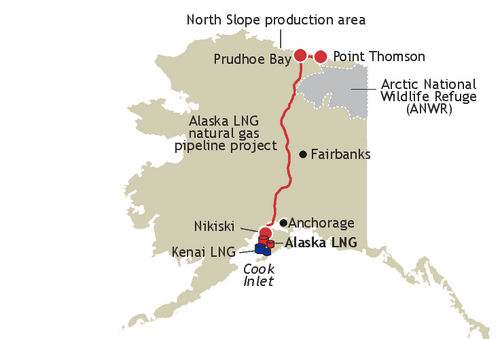
Glenfarne plans to split Alaska LNG into two phases. The first encompasses construction of a 739-mile, 3.5bn ft³/d pipeline from Alaska's gas-rich North Slope to the state's south-central coast (see map). The line would also supply the domestic market, which faces a looming gas supply shortage amid declining domestic production in the Cook Inlet. The second phase of adding the liquefaction terminal would come later with a separate financial decision. Glenfarne hopes to begin construction on the pipeline in the first half of 2027, with first flows moving in late 2029.
Under the state's existing law, Alaska LNG would be exempt from property taxes during construction. Once the project is in service, Dunleavy's proposal would replace the property tax with a volumetric tax of 6¢/1,000 ft³ of throughput on the pipeline.
The volumetric tax would apply only after throughputs reach a 30-day average of 1bn ft³/d or 10 years after the first flows, granting Glenfarne a ramp-up period and reducing its upfront tax burden. The former is unlikely to occur without the liquefaction phase. The domestic gas market along the proposed pipeline consumes less than 300mn ft³/d, according to consultancy firm Rapidian Energy.
The volume-based treatment equals about a 90pc reduction in property taxes that the state and local municipalities would collect under the existing law for oil and gas projects, according to the Alaska Department of Revenue. Legislators have proposed higher volumetric rates, up to as much as 55¢/1,000 ft³, to ensure more revenue.
A concealed cost
Though lawmakers broadly support Alaska LNG, they have questioned Glenfarne's ability to deliver the project as well as its true cost. The $44bn estimate for both phases comes from a study published in 2016. Rapidian Energy estimated last year that the project's total price tag will command between $53bn-63bn, with upside risk for labor and steel costs due to the project's remote location.
"Glenfarne was unknown 18 months ago. They have no completed N. America projects. But they want a 92pc reduction in our local property taxes," senator Cathy Giessel (R), chair of the Senate Resources Committee, wrote in a newsletter to constituents in March. "They are holding all financial information about the project confidential. This is not a good business position for our state to be in."
Dunleavy hopes the special session will provide enough time for lawmakers to receive the information they need. If not, Dunleavy told Argus he would consider calling another special session unless lawmakers outright oppose the project.