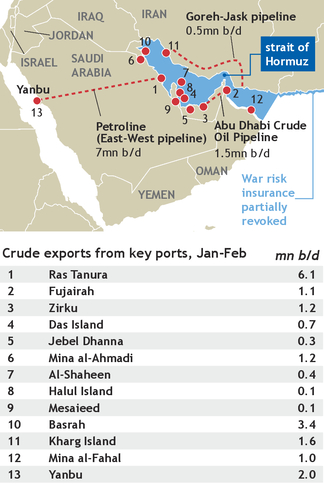
Any vessels engaging with Iran's new Persian Gulf Strait Authority (PGSA) to secure safe passage through the strait of Hormuz are highly unlikely to be owned or chartered by major tanker operators or oil companies, and will be making any toll payments to Iran without using US dollars, shipping sources tell Argus.
Tehran established the PGSA at the start of May to assert control over shipping passing through the strait, access to which Iran has severely restricted since the start of the US-Iran war at the end of February.
The PGSA said this week that more than 300 non-Iranian vessels had submitted information to it since it began operations to secure safe passage through the waterway. About 42pc of the vessels were oil tankers and 8pc LNG carriers, it said. Around 77pc of vessels submitting requests were looking to exit the strait, and 23pc looking to enter, it added, noting that of those vessels looking to exit, around 28pc were destined for China, 19pc for India and another 23pc for elsewhere in Asia.
The US Treasury Department's Office of Foreign Assets Control (Ofac) imposed sanctions on the PGSA at the end of May, and this will act as a serious deterrent to major listed oil companies and tanker operators from engaging with Iran, shipping sources say.
"Large shipping companies are typically publicly listed and can't simply make payments to Iran for transit," one broker says. "Every financial transaction is closely monitored, and payments are usually conducted in US dollars. Falling under Ofac sanctions would carry significant consequences, including the freezing of assets and accounts, making the risks substantial."
Shadow play
But the situation may be different for vessels in the so-called "shadow fleet" that has handled sanctioned trade in Russian, Iranian and Venezuelan oil in recent years, other sources suggest, or for shipowners from countries such as China that have been less concerned about US sanctions. Operators of such vessels may be able to limit their exposure to Ofac sanctions risk by settling any payments to the PGSA using local currencies such as the Chinese yuan, or via alternative mechanisms like cryptocurrency transfers. It is even possible, a shipping consultant suggests, that Iran may be looking at payment in kind, from the vessel's flag state or beneficiary state, such as military equipment or aid, which would also make it hard for Ofac to link payment directly to the actual transit.
Insurance is another consideration that would limit engagement with the PGSA, shipping sources add. "Any international insurer will have warranties on their war policies meaning normal [non-"shadow fleet"] ships cannot pay any money to [Iran's] Islamic Revolutionary Guard Corps (IRGC)," one insurance broker notes. That would deter a shipper from paying a toll to the PGSA, the broker said, although it might not necessarily prevent them from contacting the authority for permission to transit the strait.
Ofac's sanctions statement explicitly linked the PGSA to the IRGC, noting that it "extorts vessels transiting the strait of Hormuz through the so-called Persian Gulf Strait Authority, a government agency aimed at imposing illegitimate tolls on commercial traffic".
Some shipping sources also remain sceptical of the PGSA's claims, which are hard to verify given that the few vessels still moving through Hormuz routinely turn off their transponders to disguise identity and reduce the risk of attack. "I don't believe 300 owners signed up for this," a shipping source with one oil company tells Argus. "I think this is one of their media plays."