PDH operating rates have rebounded while ample domestic LPG supply from refineries has dampened import demand from China's other sectors
China's LPG import demand continued to diverge in June, with propane dehydrogenation (PDH) plants buying more propane in response to stronger margins but demand from all other sectors remaining depressed.
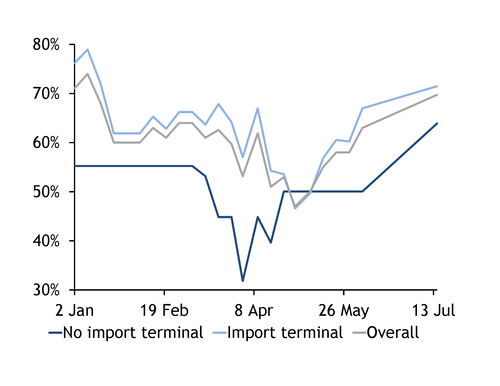
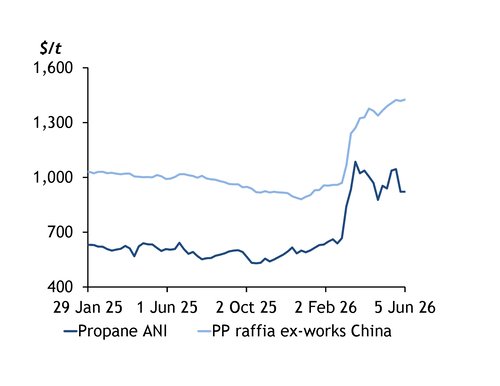
Higher propane-to-polypropylene (PP) production margins encouraged some Chinese PDH plants to restart this month, which has lifted propane import demand. Domestic PDH operating rates could rebound to 70pc by the end of the month having hit 63pc on 5 June, after falling to as low as 47pc in April as a result of the disruption caused by the US-Iran war. The recovery comes as declining PP unit run rates and dwindling inventories have lifted Chinese PP prices. PP unit utilisation fell to a low of 65pc in the week ending 6 June, down by 15 percentage points from before the start of the war and by 11 percentage points compared with a year earlier. Chinese PP raffia ex-works prices rose by 47pc from the start of the war to 9,775 yuan/t ($1,445.40/t) by 12 June, while the Argus Ningbo Index (ANI) for propane imports to east China increased by 13pc to $780.25/t.
The improving profitability is expected to lift PDH run rates at facilities with associated import terminals to around 71pc in July, and to 64pc for those buying trucked propane at higher costs, Argus data show. Chinese buyers continued to procure propane for their feedstock needs rather than for storage, market participants say. But it is still unclear whether new PDH plants that had been scheduled to start up this year will do so. State-controlled Sinopec Zhenhai's 600,000 t/yr PDH project in Zhejiang was expected to start up in the middle of this year, but it has yet to do so and it is unclear if it will happen soon.
The rise in demand from PDH plants comes as ample domestic LPG supply from refineries caps import demand from China's other sectors during a summer lull. Refineries have produced and sold more LPG because of weak demand and margins for other transport fuels, traders say. The gasoline crack spread at Bohai bay in northeast China returned to a positive $3.46/bl on 15 June, having been negative since March, but was still down from $8.33/bl on 27 February, Argus data show.
Domestic LPG prices have meanwhile risen significantly since the start of the war in the Middle East, further incentivising refiners to produce more LPG. Prices at Sinopec Guangzhou's refinery in south China rose by 41pc to Yn6,660/t by 15 June, while the Pearl River Delta Index, covering prices at import terminals in the region that serves the wholesale market, rose by 41pc to Yn6,718/t. A seasonal decline in wholesale propane demand is also raising refinery supply availability, with this tending to be butane heavy.
Glass half MTBE
Negative production margins for gasoline component MTBE — which is largely produced from butane — as a result of higher butane prices and low road fuel demand has also weighed on China's butane imports. The MTBE ex-tank price in east China rose to $780.30/t by 5 June, up by 28pc since the start of the US-Iran war, while the butane ANI price rose by 43pc to $924.50/t. even after a series of shutdowns in May.
Higher propane prices compared with naphtha also capped demand from China's flexible ethylene steam crackers. The naphtha Japan c+f price stood at $745.60/t on 9 June, a $71/t discount to the propane ANI price. Most ethane and LPG mixed-feed crackers continued to procure LPG, except for one 1.2mn t/yr cracker in north China that stopped buying LPG as it maximised internal use of naphtha and imports of ethane. China's ethane imports were estimated to reach 983,000t in June, just below the record level in April, data from analytics firm Kpler show.