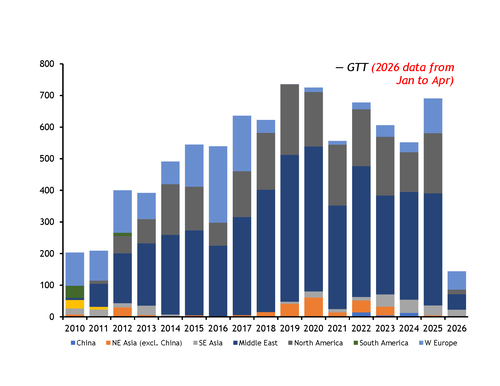
Middle East ethylene dichloride (EDC) production remains constrained heading into the third quarter despite the US-Iran ceasefire and the reopening of the strait of Hormuz, as producers face persistent vessel congestion, high inventories, and weak vinyl chloride monomer (VCM) and polyvinyl chloride (PVC) spot prices, market participants said.
Before the US-Iran war, most Middle Eastern EDC suppliers were already running at reduced rates because of weakening chlorine netbacks into EDC and lower demand from the PVC sector. Most producers were either catering for EDC contractual supplies, or for their respective PVC production, rather than supplying the EDC spot market. Asian chlorine netbacks into EDC were assessed at -$86.30/t and -$76.51/t in January and February 2026, respectively, according to Argus data.
Following the onset of the war, the closure of the strait of Hormuz made it uneconomical for domestic EDC producers to keep running since vessels could not leave the strait and domestic inventories piled up. QatarEnergy declared force majeure on deliveries of several chemical products on 9 March, while two Saudi EDC producers reduced rates heavily as they were unable to reach certain customers in south Asia.
Since then, Argus suspension PVC (s-PVC) import prices into India, Vietnam and the Gulf Cooperation Council (GCC) have fallen by 35pc, 39pc, and 21pc, respectively, as of 19 June from their peaks on 20 March. May VCM monthly spot prices also saw declines of 20pc in northeast Asia and 29pc in southeast Asia, with recent indications pointing to further drops in June.
This would bring both current PVC and VCM prices close to historical lows since before the US-Iran war, leading Middle Eastern EDC producers to reconsider increasing operating rates even as feedstock costs declined and the strait reopens. Most EDC producers are currently focusing on destocking efforts before ramping up production rates, but many expect that this will take time and likely determined by how quickly vessel congestion along the strait eases.
Concerns from India remain surprisingly low
Middle Eastern EDC supply primarily flows into India, as many PVC producers there rely on imported EDC feedstocks for their production. Total EDC imports into India in 2025 were 690,926t, with the Middle East contributing 51pc of the total, data from Global Trade Tracker (GTT) show.
As a precautionary measure over the war-related uncertainty and reliability of feedstock supplies, the Indian government introduced duty waivers across different imports — including PVC — and the prioritisation of feedstock LPG output across certain sectors.
But despite a potential delay in the resumption of EDC supply from the Middle East, along with other key feedstocks, Indian PVC producers are not so concerned over EDC supply security as some secured enough imports to meet more than three months of domestic demand. While current GTT data for 2026 is slightly delayed, EDC imports from western Europe into India between January and April 2026 were 57,776t — more than half of the full-year total for 2025.
This could lead to a potential reintroduction of PVC import duties into India beyond 30 June to control overseas supplies into the country, with senior government officials recently investigation a potential extension to duty waivers before the ceasefire. But a decision has yet to be made on this, with market participants expecting further announcements from the government in the coming days.