

Will Argentina's bumper wheat harvest lack protein?
The world’s wheat exporters are braced for a record harvest in Argentina, but the real market impact will be determined by the crop’s protein content.
Global wheat traders have been leaning towards a middling-protein, high-yield scenario for this year's Argentinian wheat crop in the run-up to the country’s new marketing year, which began in December.
A consensus has emerged that Argentina's harvest — currently in progress — will yield mostly 11.5pc protein wheat and below this year, rather than the typical 11.5-12.5pc mix of protein grades. Yields are forecast above historical averages and are set to push production to a record high. But high yields are often correlated with lower average protein content.
Some traders who have already sold on a destination basis to millers and importers in west and east Africa — typically 12.5pc protein markets — have sought to switch their vessel-loading plans from Argentinian ports to other exporters over the past fortnight, market participants said. Instead, various traders are seeking 12.5pc wheat from northern European countries and even from Brazil.

Ample 11.5pc wheat, close to no 12pc and higher
A greater share of 11.5pc protein wheat exported from Argentina this year — rather than 12pc and 12.5pc protein wheat — will intensify competition with some exporters more than others.
Argentinian wheat has already come into direct competition with French exporters offering 11-11.5pc wheat in Morocco, as traders offer on a forward basis for December shipment. Argentinian sellers started offering wheat to buyers in Morocco as early as October. A large share of 11.5pc wheat sold to Moroccan importers for December and January loading has traded on an optional-origin basis, market participants said, meaning competition between French and Argentinian exporters could intensify in the coming weeks as loadings begin.
Competition between Argentinian and French wheat could have a wider-reaching effect on global prices because of the relationship between France's physical market and Euronext physically delivered wheat futures. French exporters may have little room to reduce their offers to compete with Argentina, given that exporters are already paying a sizeable premium to Euronext March wheat futures to secure the physical grain from French farmers in the country’s domestic market.
Argentinian wheat has also been the most competitive origin of lower-protein milling wheat in southeast Asian delivered markets since early September. Sellers offering Argentinian wheat have pulled buyers' attention away from competing Australian Standard White 9pc protein wheat, and have almost completely pushed Black Sea origins out of the region in the past two months.
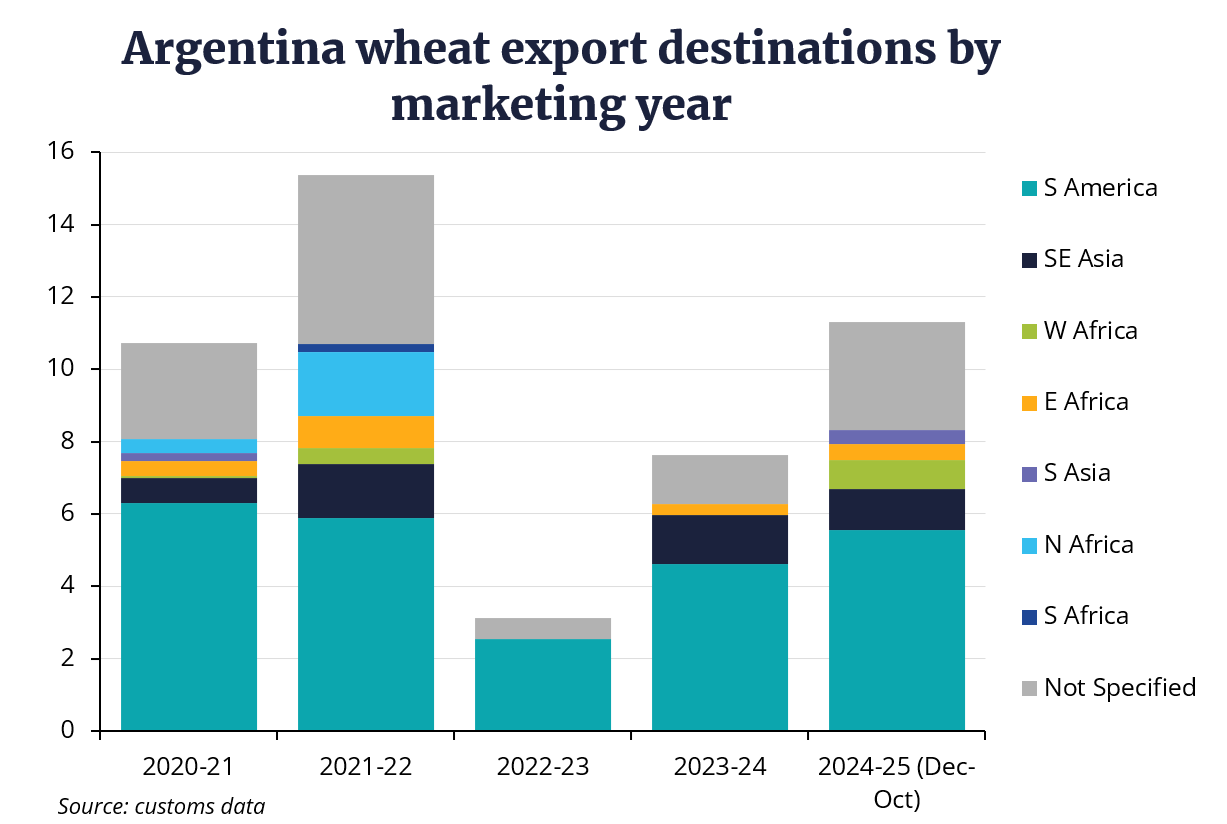
Moreover, Argentina's export window could overlap with its competitors for longer than usual this year, given the large crop coupled with a slow start to exports in the first half of the EU and Black Sea's July-June marketing year. Argentina's wheat exports would typically be absorbed by other countries in South America in the first months of the December-November marketing year, especially in years of lower Argentinian exports (see chart). But the country tends to ship earlier to destinations in southeast Asia and Africa in years when it has a higher exportable surplus.
Smaller share of milling wheat, ample feed wheat output
Traders' reactions have so far leaned towards the scenario of a large share of 11.5pc wheat in Argentina's exports this year. But a number of Argentinian sellers quoting low-protein 9.0-10.5pc wheat — unsuitable for most millers — and even wheat with no protein guaranteed has raised some doubts in the wider market.
Global milling wheat prices could find some support across the board if strong yields in Argentina boost the share of feed wheat in this year’s harvest at the expense of the 11.5pc protein milling grade. As well as tightening the milling market, a greater supply of feed wheat from Argentina could weigh on already ample supply across the feed grains complex in the Americas. A large Argentinian feed wheat crop could add to high corn supply anticipated from Brazil, and provide some breathing room if US corn exports prove lower than previously anticipated.
Author name: Claudia Jackson: Associate Editor and Anna Harouni: Deputy Editor, Agriculture


