
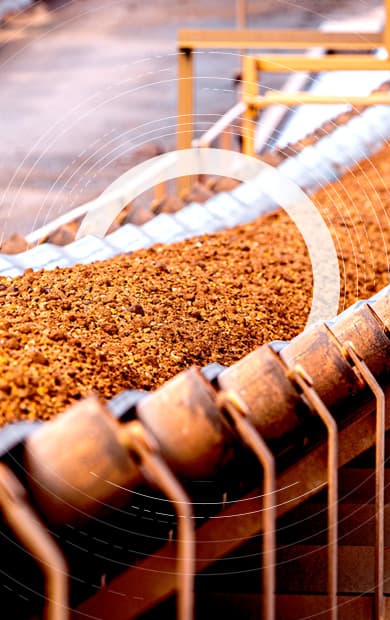
Steel raw materials
Overview
Argus’ comprehensive coverage of the global ferrous markets provide independent price assessments, news and market analysis for iron ore, coking coal, ferrous scrap, pig iron and steel.
Our global team of experts in China, Singapore, the UK and US deliver over 300 domestic and seaborne price assessments along with detailed market commentary on a daily basis to ensure our clients have complete mine to mill price coverage.
The ferrous portfolio includes established Argus price indices for 62pc and 65pc iron ore fines, Turkish ferrous scrap imports, and our fob Australia and cfr China premium hard coking coal indices.

Stay ahead of the ferrous metal markets
To be informed of relevant content, sign up to Argus Ferrous Market Highlights. Each newsletter issue provides key prices, selected news, downloadable insight papers, podcasts, and on-demand videos across the global ferrous markets. Our coverage spans steelmaking raw material markets, including coking coal and iron ore, steel markets, including flat, long and semi-finished, as well as line pipe and OCTG markets.
Sign up nowLatest steel raw materials news
Browse the latest market moving news on the steel raw materials industry
Swiss Trasteel to list on Nasdaq
Swiss Trasteel to list on Nasdaq
London, 14 April (Argus) — Lugano-based steel trader Trasteel intends to list on the Nasdaq stock exchange, according to a regulatory filing seen by Argus . Trasteel intends to link up with a Cayman Islands-based special purpose acquisition company, Sizzle Acquisition Corp. II, to form a new Luxembourg-based entity, Pubco, with a Cayman Islands wholly-owned subsidiary. Trasteel and Sizzle II intend to list Pubco, in which both will be shareholders, with the transaction expected to close by the end of 2026. Trasteel said it has more than $1.8bn in revenue from over 1.5mn t/yr across steel, energy, metallics, derivatives, non-ferrous and ferro-alloys businesses, according a presentation seen by Argus , with $60mn in earnings before interest, taxes, depreciation and amortisation (Ebitda) last year and $7.5mn in profit. The presentation said the war in Iran represented an opportunity for its business and would be positive for Ebitda. The merger values Trasteel at $800mn. It also said Trasteel Holding has no debt, with all debt at a subsidiary level ring-fenced with no parent guarantee, and "structurally segregated from the trading perimeter". Trasteel is currently owned by Fratelli Cosulich, Fantex and Trasteel chief executive Gianfranco Imperato. Trasteel's existing shareholders will roll over all their equity as part of the deal, which Sizzle said will give the combined business a pro forma enterprise value of about $1.32bn. Equity released from the transaction will be used to expand the trading platform through "onboarding of senior traders from major competitors". Trasteel had been interested in acquiring major steel trader Dith with a Chinese partner, when Dith's owners were looking to sell the business. Talks with an Abu Dhabi sovereign wealth fund appear to have stalled. "We anticipate global demand for steel and other metals to continue to increase and believe that Trasteel is well-positioned to benefit by such increased demand," Sizzle II vice-chairman Jamie Karson said. "The Trasteel team, led by Gianfranco Imperato and CFO [chief financial officer] Federico Guiducci, is highly experienced, strategic and focused on delivering results for its shareholders. We are thrilled to bring this quality company to market." By Colin Richardson Send comments and request more information at feedback@argusmedia.com Copyright © 2026. Argus Media group . All rights reserved.
China's CATL, Jianlong to scale truck electrification
China's CATL, Jianlong to scale truck electrification
Beijing, 13 April (Argus) — China's largest battery manufacturer CATL and private-sector steel group Jianlong signed a strategic co-operation agreement on 10 April, aimed at accelerating the decarbonisation of steelmaking and mining through greater electrification and renewable energy deployment. Under the agreement, the two companies will co-operate across areas including the electrification of steel industry operations, development of green and intelligent mines, and the electrification of logistics. They plan to deploy more than 3,000 electric heavy trucks during China's 15th five-year plan period (2026-30), roll out battery-swapping infrastructure along at least 16 logistics hub routes, and build and operate 100 battery-swapping stations. The partnership will also advance the development of centralised and distributed wind and solar projects, using Jianlong's industrial parks as pilot sites. The two sides aim to build a full-chain, zero-carbon model covering mining, transportation, energy and materials, creating a replicable template for industrial decarbonisation, CATL said. CATL and Jianlong said the initiative is intended to demonstrate integrated pathways for emissions reduction in heavy industry and logistics, supporting China's broader push to reduce industrial carbon intensity while promoting the large-scale adoption of electric heavy vehicles. CATL in November 2024 released its Tianxing series batteries used in heavy commercial vehicles. CATL's Tianxing heavy commercial vehicle ultra-fast-charging battery allows vehicles to replenish 70pc of energy within 15 minutes. The battery also offers an ultra-long lifespan of up to 1.2mn km, a maximum capacity of 600kWh, and a driving range of up to 500km. In short-haul applications such as mining transport and construction material mixing, the technology can significantly reduce charging time for electric heavy trucks, it said. China's new-energy heavy truck market maintained rapid growth in the first two months of 2026, extending last year's expansion and reinforcing pressure on the country's diesel demand just as domestic diesel prices surged in March. The country's sales of such trucks reached 233,200 units in 2025, almost tripling on the year, according to Chinese research institute EV Tank. Send comments and request more information at feedback@argusmedia.com Copyright © 2026. Argus Media group . All rights reserved.
US inflation quickens to 3.3pc in March, gasoline soars
US inflation quickens to 3.3pc in March, gasoline soars
Houston, 10 April (Argus) — US inflation surged to an annual 3.3pc in March, lifted by higher war-driven energy costs, including the largest monthly gain for gasoline on record. The consumer price index rose at the fastest pace since mid-2024, climbing from 2.4pc in the 12 months through February, according to the Bureau of Labor Statistics (BLS). The gain was in line with estimates of economists surveyed by Trading Economics. Energy rose to an annual 12.5pc in March compared with a 0.5pc annual gain in February. The 10.9pc monthly gain in energy was the largest for a single month since September 2005. Gasoline surged by an annual 18.9pc in March after falling by 5.6pc in February. Gasoline's monthly gain was 21.2pc, the largest monthly gain since records began in 1967, according to BLS. Fuel oil rose by 44.2pc in March from a year earlier, following a 6.2pc annual gain in February. The 30.7pc monthly gain in fuel oil was the highest monthly gain since February 2000, according to BLS. Energy services rose by an annual 5pc in March compared with a 6.3pc gain in February. Electricity rose by 4.6pc compared with a 4.8pc gain in February. Airline fares rose by 14.9pc following a 7.1pc gain the prior month. Core drop, flat Fed rate still expected So called core inflation, which strips out more volatile food and energy, rose by 2.6pc compared with a 2.5pc gain the prior month. "Looking ahead, core CPI inflation still looks set to fall this year, now that nearly all the tariff costs have been passed through to consumer prices, unit labor costs are rising at a sub-2pc pace, and new rents are essentially flat," Pantheon Macroeconomics said in a note. Fed funds futures suggest the Federal Reserve is likely to keep its target rate unchanged at 3.5-3.75pc through the end of the year, with about a 24pc probability of one quarter-point rate cut by December and just a 1.1 point chance of a rate hike. Services less energy services, considered core energy services, rose by 3pc compared with a 2.9pc gain the prior month. Medical care services rose by 3.7pc following a 4.1pc annual gain. Food rose by an annual 2.7pc following a 3.1pc gain. Meat rose by 6.8pc, down from 8.6pc. Shelter rose by 3pc, unchanged from the prior month. New vehicles rose by 0.5pc while used vehicle prices fell by 3.2pc in March from a year prior, both unchanged from a month earlier. By Bob Willis Send comments and request more information at feedback@argusmedia.com Copyright © 2026. Argus Media group . All rights reserved.
Argentina sanctions glacier-protection reform
Argentina sanctions glacier-protection reform
Sao Paulo, 9 April (Argus) — Argentina's lower house has approved a wide-reaching reform to the country's glacier-protection law, which is expected to give a major boost to its copper industry. Argentina's lower house approved a reform that allows Argentinian provinces to decide which glaciers are important to their water resources and which are not. The "non-functional" glaciers would then be allowed to become mining sites, mostly benefiting copper mining. The approval was widely expected after the country's senate cleared the reform on 27 February. President Javier Milei strongly backed the reform, which ensured that his party and allies that usually side with the administration in big votes made up the necessary majority in both the Senate and in the lower house. The bill was approved late on 8 April by a 137-111 vote, with three abstentions. The bill needed 126 votes to pass. It is only a matter of time before Milei officially promulgates the law reform. The updated legislation is expected to be a major boost to Argentina's stagnant copper-mining industry , as several resources of the red metal are found within the glaciers' perimeters. The country's mining secretary released a report in early February forecasting that Argentina would account for 6.1pc of world' copper production by 2035 at over 1.5mn metric tonnes (t)/yr. This projection now becomes possible after the reform. Argentina's 20 most-advanced copper projects represent a combined $21.9bn in investment, and all are now positioned to significantly expand their resource bases as operators are permitted to work within glacier perimeters. Most of the country's copper reserves lie along the Andes mountain range on the border with Chile — an area that, on the Argentine side, is extensively glaciated. The reform, coupled with Argentina's intentions to bolster its incentive regime for large investments, could attract new foreign investment to the country's copper industry. Despite having 116mn t of copper resources, it was only able to export $4bn of the metal last year — while Chile, which is located on the other side of the Andes, sold $50bn, according to Milei. Javier Milei's office celebrated the approval, saying the reform eliminates "ideological distortions and artificial obstacles that hampered progress". His office had previously stated that the law, in its original form, allowed for misinterpretation that created legal uncertainty, curtailed investments and deprived provinces the right to regulate their natural resources. The original law, among other restrictions, forbade mineral exploration and extraction within the glaciers' perimeters, which was then set by the Argentinian institute of nivology, glaciology and environmental sciences (IANIGLA) based on unclear criteria, Milei said on 14 November. Major backlash ensues Changes to the glacier-protection law have caused a major backlash from political adversaries of Milei and the general public in Argentina. Greenpeace activists carried out peaceful protests in front of the lower house building, in Buenos Aires, and clashed with the police. Congress members, lawmakers and environmental organizations that oppose the reform all agree that easing the protection of glaciers could threaten Argentina's water security. Greenpeace said during the 8 April protests that this would be opening a path to destroy most of Argentina's glacial environment, putting the country's water security at risk. The glaciers' meltwater regulates rivers all across the country and serves as the primary feedstock for several agricultural projects. "We demand that this reform does not move forward, as it puts Argentina's main drinking water reserves at risk," Greenpeace said in a statement. Nevertheless, the reform was approved, and its supporters insist that no province will permit glaciers vital to the nation's water resources to be turned into mining sites, which remains to be seen. By Pedro Consoli Send comments and request more information at feedback@argusmedia.com Copyright © 2026. Argus Media group . All rights reserved.
Spotlight content
Browse the latest thought leadership produced by our global team of experts.

Turkey's flat steel trade patterns set to shift in 2026
Iron ore’s future in balance as China jettisons benchmark
China has adopted new indexes to price iron ore imports, divorcing the physical market from the reference underpinning a vast futures ecosystem.
Opportunities and risks for the Indian steel market in 2026
Explore our steel raw materials products
The Argus ferrous portfolio includes over 1,600 assessments and delivers unbiased price data, reports and market commentary from across coking coal, iron ore, ferrous scrap, steel and relevant freight rates.
Key price assessments
Argus prices are recognised by the market as trusted and reliable indicators of the real market value. Explore some of our most widely used and relevant price assessments.