Overview
US sanctions on Venezuela’s national oil company PdV, first imposed on 28 January 2019, cast another layer of geopolitical uncertainty onto the international oil market. The sanctions take effect in stages, gradually intensifying their impact on the Opec country’s imports and exports.
For international oil companies, traders and governments around the world, the sanctions rollout and partial unwinding of commercial ties will help to shape near-term market dynamics, with longer-term implications for energy policy and investment.
Follow along with Argus as we deliver the latest news and market analysis on this fast-developing story.
Timeline: Key Venezuela sanctions dates

Related news and analysis
Seized oil tanker likely heading to Houston
New York, 12 December (Argus) — The US-seized oil tanker Skipper, carrying Venezuelan oil, is en route to Houston, Texas, according to data from oil analytics firm Vortexa. If Houston is the very-large crude carrier's final destination, it will likely discharge the 1.9mn bls of Merey crude it is carrying via lightering offshore since Houston-area ports are too shallow to allow such a large ship dock to offload at an onshore terminal. The US seized the falsely-flagged Skipper on 10 December for its alleged involvement in smuggling Iranian oil to support Lebanon-based Hezbollah and Iran's Islamic Revolutionary Guard. But the seizure is widely seen as an extension of ongoing efforts by the US to pressure the Venezuelan government over the flow of drugs from the country. The US said it intends to seize other tankers on existing sanctions lists that are carrying Venezuelan crude. The US has stationed a large naval force in the waters near Venezuela since September as part of an effort ostensibly aimed at stopping waterborne drug shipments. The seizure of the Skipper has not had any clear effect on freight or crude markets so far, but more seizures and Caracas' response could change that. The US tried to pressure Iran through ship seizures from 2019-24, seizing a total of nine tankers, including four vessels in 2020 that were due to deliver Iranian gasoline cargoes to Venezuela. The US discontinued the practice because Tehran retaliated by seizing tankers passing through or near the strait of Hormuz at the entrance to the Mideast Gulf. Venezuelan president Nicolas Maduro's government calls the seizure of the Skipper "an act of international piracy", but Caracas may not have the same capability to retaliate as Tehran. It could block loadings by Chevron, which is importing oil to the US under a sanctions waiver that the US reissued in August. Exports to the US, shipped under Chevron's waiver, stood at about 130,000 b/d in November, down from 150,000 b/d in October. By Charlotte Bawol and Haik Gugarats Send comments and request more information at feedback@argusmedia.com Copyright © 2025. Argus Media group . All rights reserved.
More than 30 sanctioned tankers in Venezuela
New York, 11 December (Argus) — More than 30 tankers could be within the reach of US naval forces positioned near Venezuela if Washington decides to continue seizing ships on its sanctions list. "There are 37 undeparted OFAC-designated tankers currently in Venezuela," Samir Madani, chief executive of independent vessel tracking service Tanker Trackers, told Argus — referring to the Treasury Department's sanctions enforcement arm, the Office of Foreign Assets Control (OFAC). "Maybe one or two departed recently, but that's the ballpark for now, at least." The US seized the tanker Skipper on 10 December, saying it was on the OFAC sanctions list. The ship was falsely carrying the Guyana flag , Guyana's maritime agency Marad said, but was flying the Panama flag up until 2023, according to the International Maritime Organisation (IMO) database. The tanker was transmitting falsified AIS positions to conceal its location, according to Kpler. Tanker Trackers estimated it to be laden with around 1.85mn barrels of Merey-16 crude. The ship had sailed as Adisa starting in 2021 before being renamed the Skipper . The US sanctioned the tanker in 2022 for its alleged involvement in an international oil smuggling network that blended and exported Iranian oil in support of Lebanon-based Hezbollah and Iran's Islamic Revolutionary Guard Corps. Former names for Skipper include the Toyo , the name it adopted in 2005, and Maera , the name it changed to in 2019, according to the IMO registry. Overall shipping operations in the Caribbean region today seem fairly normal and freight rates in the region are steady, according to shipbrokers. Chevron resumed imports of Venezuelan crude to the US in August following the reinstatement of its sanctions waiver . More sanctions Separately, the US Treasury Department on Thursday announced sanctions on six tankers — White Crane, Kiara M, H Constance, Lattafa, Tamia and Monique — and six shipping companies it said transported Venezuelan crude in recent months. Treasury last targeted specifically Venezuela-linked tankers in January 2021. The White House said more tankers could be seized. "We're not going to stand by and watch sanctioned vessels sail the seas with black market oil, the proceeds of which will fuel narcoterrorism of rogue and illegitimate regimes around the world," it said. Fewer tankers The number of irregular tankers off the coast of Venezuela already declined in November for the first time since one non-governmental organization began measuring them in July. Tankers identified as likely to be moving sanctioned crude or other products from Venezuela dropped to 17 in November, from 24 in October, the Venezuelan chapter in exile of Transparency International said on Thursday. The figures are based on a narrower set of criteria than the Tanker Trackers figures. The group estimated there were about 12 that arrived in July. But about 41pc of traffic at Venezuela's oil ports still includes sanctioned or otherwise suspect vessels, the group estimated. The presence of all types of oil tankers offshore of Venezuela also declined slightly in November, to 98 from 112 in October. By Charlotte Bawol and Haik Gugarats Send comments and request more information at feedback@argusmedia.com Copyright © 2025. Argus Media group . All rights reserved.
Seized oil tanker 'falsely' carrying Guyana flag
Kingston, 11 December (Argus) — An oil tanker seized by the US off Venezuela's coast on Wednesday was falsely carrying the Guyana flag, Guyana's maritime agency Marad said. The very large crude carrier Skipper is part of "the proliferation of an unacceptable trend of the unauthorized use of the Guyana Flag by vessels that are not registered in Guyana," Marad said. The ship was seized as a large US naval force remains stationed offshore Venezuela that Washington said is intended to stop drug shipments. Venezuela has protested against the naval presence, saying is intended to topple the administration of president Nicolas Maduro, and called the seizure of the ship "an act of international piracy." The US told Marad it encountered Skipper , which has gone by other names and has been used in moving sanctioned Iranian crude, in international waters, Marad said. The ship appeared to be destined for Cuba before the seizure, but since then has been moving slowly to the northwest and is showing a destination of Georgetown, Guyana. Marad said it will continue to work with other organizations and governments to identify and take action against unauthorized use of the Guyana flag. By Canute James Send comments and request more information at feedback@argusmedia.com Copyright © 2025. Argus Media group . All rights reserved.
Trump's Venezuela tactics draw ire from Congress
Washington, 1 December (Argus) — US president Donald Trump's heavy-handed approach to Venezuela has drawn a rare bipartisan rebuke from Congress — even before he makes good on his threat to attack the country. The top Republicans and Democrats on the Senate Armed Services Committee and the House Armed Services Committee said over the weekend they will examine the circumstances of a strike the US military carried out in early September near Venezuela, destroying a boat allegedly carrying drugs. The large US naval force deployed near Venezuela since September has destroyed around 20 small boats and Trump said on 27 November that he would order land strikes against Venezuela soon. What prompted scrutiny from Congress is a 28 November story by The Washington Post that defense secretary Pete Hegseth in September ordered the US military to kill survivors of the first US strike on the boat allegedly carrying drugs in the international waters off Venezuela's coast. "There can be no conceivable legal justification" for the reported follow up attack, said Jack Goldsmith, who headed the Justice Department's Office of Legal Counsel in 2003-2004, under former president George Bush. "If the Post's facts are correct, it appears that [the US military] committed murder," Goldsmith said. House committee chairman Mike Rogers (R-Alabama) and ranking member Adam Smith (D-Washington) said on Sunday they took the report seriously and will take "bipartisan action to gather a full accounting of the operation in question." A day earlier, Senate committee chairman Roger Wicker (R-Mississippi) and ranking member Jack Reed (D-Rhode Island) said they would conduct "vigorous oversight to determine the facts related to these circumstances". Hegseth did not explicitly deny the report at first. "As we've said from the beginning, and in every statement, these highly effective strikes are specifically intended to be 'lethal, kinetic strikes'", he said on 29 November. But on Sunday, the Pentagon described the story as "fake news" and Trump added that Hegseth "said he did not say that and I believe him, 100pc." But Trump added that he "wouldn't have wanted" a follow up strike against the survivors. Senior lawmakers briefed on the Trump administration's legal rationale for the strikes have pointed out that it makes no explicit reference to Venezuela and describes the US operations as a "non-international armed conflict" with an unspecified group of "designated terrorist organizations". The Trump administration had sparred with US lawmakers about the legality of its military orders even before the latest developments. The Democratic members of Congress who previously served in the military issued a statement last month reminding active US military personnel of their duty to defy illegal orders by their commanders. Trump called the statement "seditious" and suggested that it was "punishable by death". The Pentagon announced an investigation into one of the lawmakers, senator Mark Kelly (D-Arizona), a former astronaut and Navy pilot. Talking with Maduro Scrutiny from critical lawmakers may not deter Trump if he decides to proceed with attacking Venezuela. But it does not appear that Trump has made up his mind. Trump on 27 November spoke by phone with the US military personnel stationed on ships off Venezuela's coast and told them that land strikes will start soon. He also posted on his social media platform that day that Venezuelan airspace should be considered "CLOSED IN ITS ENTIRETY". But on Sunday, he told reporters who asked him to clarify his statements, "Don't read anything into it." Trump also said he had spoken with Venezuelan president Nicolas Maduro recently, without providing any details. The US administration describes Maduro as the head of a terrorist organization that is also a drug cartel. Trump on Sunday pardoned former president of Honduras, Juan Orlando Hernandez, who was serving a sentence in US jail following a 2024 conviction for drug trafficking. "The people of Honduras really thought he was set up and it was a terrible thing," Trump said. "Take any country you want. If somebody sells drugs in that country, that doesn't mean you arrest the president and put him in jail for the rest of his life." The show of US military force has not affected Venezuela's overall oil exports. Flows of Venezuelan crude to the US allowed under waivers have slowed since mid-November, pushing more of its roughly 1mn b/d of supply into the illicit market for sanctioned crude in China's independent refining sector and depressing prices for Venezuelan grades. By Haik Gugarats Send comments and request more information at feedback@argusmedia.com Copyright © 2025. Argus Media group . All rights reserved.
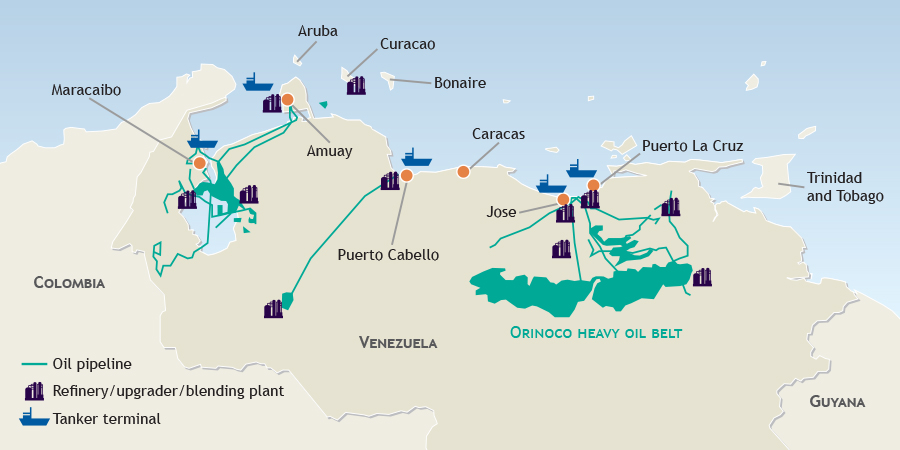
Map: Primary Venezuelan oil assets