China's new trade tariffs on styrene monomer for countries it accuses of anti-competitive behavior could potentially benefit US exporters also hit with the duties, market participants say.
The anti-dumping duties (ADD) announced on 12 February, effective on 13 February, range from 9.2-10.7pc and vary by seller.
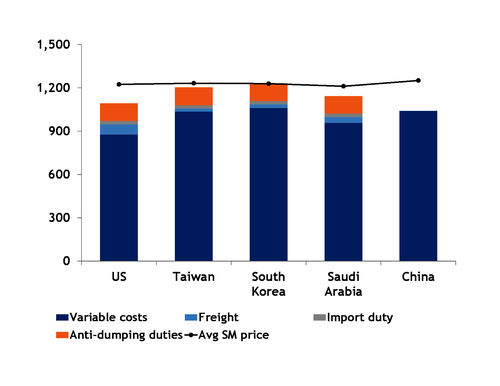
One anticipated outcome in the near-term is that US prices will adjust to levied ADD cfr China prices, which will shrink margins for sellers. Margins held near $395/t last year over raw materials costs. Currently, styrenestands at a $567/t over raw materials costs on a contract basis. Today, an additional $140/t cost to styrene would cut into margins, but allow $255/t of margin, based on 2017 margins levels.
The US shipped 10pc of China's imported styrene volume in 2017, compared with 7pc from Taiwan and 35pc from South Korea. Although the US has the highest range of duties added on prices, it also has lower incremental production costs compared with other countries facing the same tariffs. The US could give the US a competitive economic advantage in exporting styrene to China in the near-term.
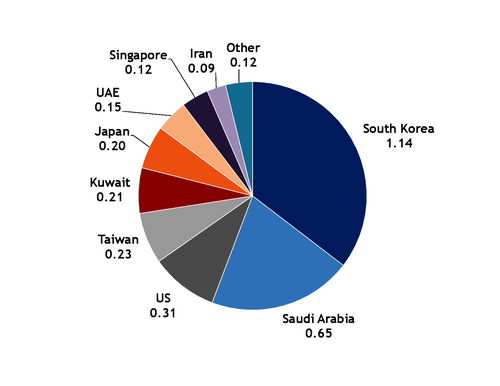
Even with an added 500,000t/yr of capacity in China this year, China will be net short styrene. The country imported 3.2mn t/yr of styrene in 2017, of which 1.7mn t/yr was imported in total from the US, South Korea and Taiwan.
On the contrary, other countries not impacted by ADD, such as Saudi Arabia — which accounted for 20pc of all Chinese imports of styrene in 2017 — could increase exports to China. But given the raw material advantage that US sellers have globally on styrene exports, swaps for US material in non-ADD countries could allow for US styrene to indirectly enter China.
Some US sellers are entertaining options of re-routing exports to other countries, with China as a final destination. In particular, Europe and South America emerge as strong contenders for a primary outlet for more US styrene. The US already ships styrene to both regions. But as the US typically stands at a discount to global prices, Europe may become the best netback more frequently year-round. Participants expressed a simultaneous concern that this could result in reducing Europe styrene unit operating rates.
The formula for calculating the ADD margins is: cfr China price in US dollars/t x (1 + original tariff + ADD) x (1 + value added tax).
Interested parties had ten days to submit written comments in response to the preliminary ADD announcement, which fell during the lunar new year in China from 15-21 February.
Near-term concerns surrounding styrene contracts based on indexes using a cfr China price have surfaced following the ADD announcement. Consideration of pricing imports on a duty delivered paid basis has surfaced as a method of normalizing prices from various countries and companies with different anti-dumping duties.
Currently, US styrene prices stand at an unusual premium to global styrene prices, as three units have curtailed output because of planned and unplanned outages. Participants estimate that US prices will become more competitive once normal production rates resume at three major styrene units, but estimates for when that will happen range from late April to early July.
Some US producers are considering shipping more molecules of feedstock ethylbenzene (EB) or polystyrene (PS) as an alternative to styrene. But EB margins are considerably smaller than styrene margins. This could also require adjusted styrene operation rates to provide ample material availability, since most EB is converted to styrene. PS pellet export costs are also significantly higher than moving liquid styrene, and freight costs could stymie movement of product further downstream.
The US sometimes imports expandable polystyrene (EPS) and PS from China. However, should Chinese EPS and PS sellers need to pass additional styrene costs to end-users in response to higher priced styrene in China from ADD, the US could see tighter EPS and PS markets or increased substitution for polypropylene, polyethylene or polyethylene terephthalate.
Another unclear opportunity for exports includes those US-based producers with styrene units in Canada. Consideration as to whether styrene could be shipped by rail and then by vessel to China at a competitive rate from Canada was heard, but initial calculations for those specific producers were unavailable.
China has previously passed anti-dumping duties on other petrochemical commodities, including caprolactam and phenol, prior to increased domestic production coming online in the country.