South Korean delivered coal prices edged down on lower freight and a milder outlook, but NAR 5,800 kcal/kg fob Newcastle prices moved higher amid fresh tender activity.
Argus assessed NAR 5,800 kcal/kg coal at $87.45/t cfr South Korea and $76.54/t fob Newcastle. This was down by $0.13/t and up by $1.14/t, respectively.
Capesize freight rates in the region fell this week, with the east Australia-south China route down by about $2/t on the week, according to Argus' assessments.
South Korean independent power producer (IPP) GS Donghae Electric Power this week procured Australian and Russian coal in a tender. The utility bought March-loading NAR 6,000 kcal/kg Australian coal and NAR 5,800 kcal/kg Russian coal at $86/t fob Dalrymple Bay and $93/t fob Russia, respectively, and a cargo of NAR 5,400 kcal/kg Australian coal for $84/t fob Gladstone for loading in late February — all prices are on a NAR 6,080 kcal/kg price basis.
Fellow South Korean IPP SGC Energy awarded NAR 5,650 kcal/kg Australian coal at $65.50/t fob Newcastle on a NAR 6,080 kcal/kg basis, with the price lower than similar deals because of a relatively high 20pc ash content.
Weather models for South Korea now predict unseasonably mild conditions in Seoul through February and peak power demand has retreated from record highs earlier this month. But the government has kept coal-fired plant restrictions to a minimum, at least early in February, which suggests some concern about overall supply or current firm spot LNG prices.
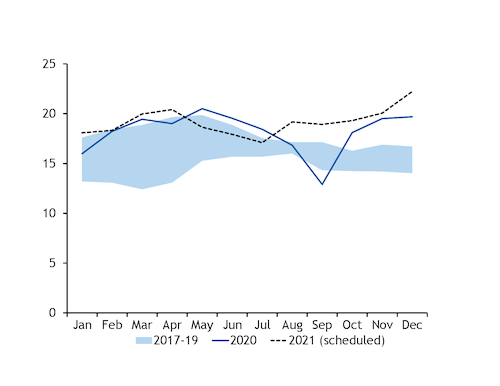
The only shutdown added to the short-term schedule was the 500MW Hadong 8 unit, which will be off line for most of February and March, according to Korea Power Exchange. As it stands, 7-13 units will be off line each day in February — an average of 6GW — which would be down slightly from 6.5GW in February 2020. But more suspensions will likely follow, as the government said at the start of winter that 9-16 units would be idle each day from December-February.
Seoul temperatures will be several degrees above the long-term mean until the middle of February except for two days, according to forecasts by meteorologist Speedwell Weather, and seven-day average peak power demand has slipped back down below the 2018-20 average. In addition, nuclear availability is scheduled to average 18.3GW in February, from 18.1GW in January and from actual output of 18.2GW in February 2020, likely trimming combined coal and gas burn.
Nuclear availability could rise further, to nearly 20GW, in March as heating demand continues to trail off, which will probably free the government to significantly lift coal restrictions for March, as it did last year.
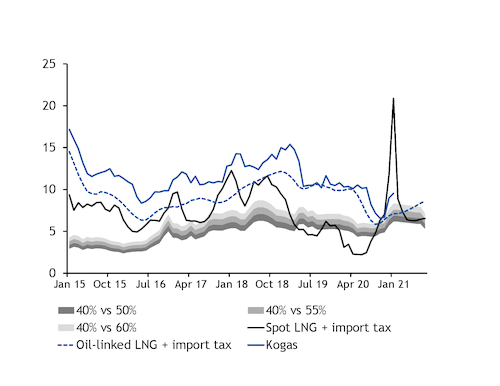
Domestic gas and spot LNG prices remain above the 40pc coal-switching price for South Korean gas-fired plants and are therefore not competitive with coal on cost. But spot LNG prices are retreating quickly from their earlier highs and Argus' forward prices suggest they will fall back below coal-switching prices from March.
This could put some pressure on spring and summer coal burn as some private gas-fired capacity would move ahead in the merit order, although state-owned gas-fired plants reliant on supply from Kogas may be the first units displaced. Oil-linked LNG prices, which correlate closely with Kogas' domestic tariff, are set to rise gradually throughout the first half of this year.