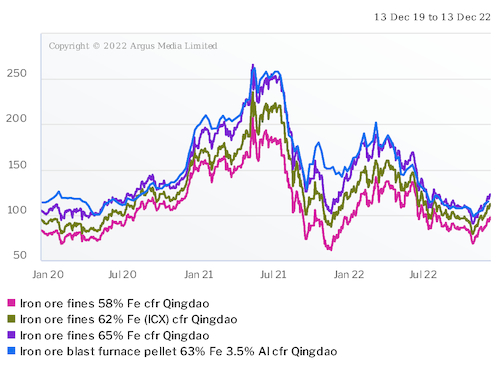
Australia's marginal iron ore mining firms are preparing to restart operations in 2023 in the hope that China's reopening from Covid-19 lockdowns will bolster demand and prices, but realising stronger demand could add to the highly inflationary cost environment.
Most of Australia's smaller marginal iron ore mines have shut in the past 18 months. Even Mineral Resources (MinRes), with its much larger balance sheet and ability to absorb some cash losses, started to look at alternate production strategies in October to cut loss-making low-grade fines production.
But the market began to swing in favour of these marginal producers in the final weeks of 2022. First freight rates and then the Australian dollar fell, cutting the cost of delivering iron ore to China. The lump premium (or, as producers see it - the fines discount) reduced and the prospects of China coming out of its self-imposed Covid-19 lockdowns saw the iron ore price complex start to recover.
CuFe was the first to point out that things were improving and could lead to the relatively high-grade producer restarting its JWD mine in 2023. The adjacent C4 mine could follow quickly, with the mines shipping blended cargoes to customers in Asia.
C4 was reopened in early February 2022 when the Argus 58pc Fe price was at $123.40/dry metric tonne (dmt) cfr Qingdao and the Argus ICX iron ore was at $147.10/dmt cfr Qingdao on a 62pc Fe basis. It was closed again in July when prices fell below $90/dmt and $100/dmt, respectively.
While prices have recovered from the lows of $68.45/dmt for 58pc Fe and $79/dmt for 62pc Fe seen on 31 October, they still have some way to go to hit the levels that prompted the reopening of C4 last year.
Prices will likely need to be higher than a year earlier to prompt mine reopening as the cost of mining has jumped, particularly in WA where skills shortages are leading to wage increases. Add to that economy-wide inflation, rising energy costs and higher cost of finance as a result of rising interest rates.
Costs will also be under pressure from items associated with rising iron ore prices. Stronger demand from Chinese steelmakers will most likely lead to a rebound in freight rates, particularly as some iron ore ships have been repurposed for the increase in long-distance grain deliveries, because of Russia's invasion of Ukraine. Higher iron ore prices also lead to higher royalties and in most cases are associated with a stronger Australian dollar. A stronger Australian dollar increases the cost of mining in Australia, particularly in a high wage environment.
Marginal mining firms will benefit from the easing of diesel prices from record highs this year, although they are still higher than they were in 2021. Small miners are particularly sensitive to diesel prices because many of them rely on trucking ore long distances to ports or rail load out facilities, and they do not have the available capital to invest in rail, electric trucking or large scale renewable energy.
These cost issues will be overcome if Chinese lockdowns ease and iron ore prices return to above $140/dmt for 58pc Fe and $150/dmt for 62pc Fe. In the meantime, Australia's marginal iron ore mining firms are maintaining their equipment and ensuring that they are ready to spring into action as soon as it is profitable to do so.
| Australian marginal iron ore projects | ||||
| Firm | Project | Capacity (mn t) | Fe content (%) | Status |
| Fenix | Iron Ridge | 1.2 | 64.0 | still operating, hedged |
| CuFe | JWD | 1.0 | 63.7 | suspended |
| GWR | C4 | 1.0 | 60.7 | shut |
| Nathan River Resources | Roper Bar | 2.0 | 58.5 | unknown |
| NT Bullion | Frances Creek | 2.0 | 59.0 | nothing shipped since June |
| Venture Minerals | Riley | 1.0 | 57.0 | suspended |
| Mount Gibson | Shine | 1.5 | 59.4 | shut |
| Strike Resources | Paulsens East | 1.5 | 62 lump and 59 fines | suspended |
| Shree Minerals | Nelson Bay River | 1.4 | 58.0 | awaiting approvals |
| Source: Company reports | ||||