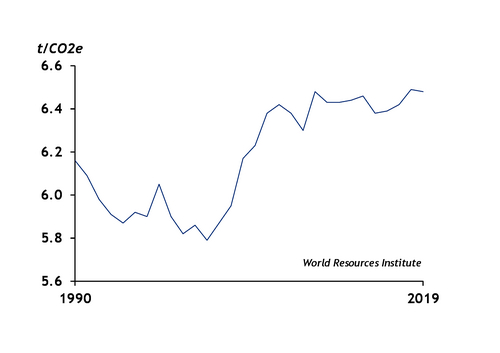
Global emissions per capita were near a record high in 2019, the latest data show, but the rate of increase has slowed to hold broadly flat in recent years, research from the non-profit World Resources Institute (WRI) found.
The rate of global emissions was 6.48 t/CO2 equivalent (CO2e) per capita in 2019, WRI data show — equivalent to the rate for 2010 and a slight decrease from 6.49 t/CO2e in 2018. The level of per capita emissions held broadly steady between 2010 and 2019, after an increase of 11.9pc between 2001-10.
"The world is slowly diverging from its previous path of carbon intense development," WRI said. Land use emissions are reported every five years, making changes easier to gauge over a longer timeframe.
Of the top 10 overall emitters — the US, Russia, South Korea, Iran, Japan, China, Indonesia, the EU, Brazil and India — there were substantial differences. India's per capita emissions of 2.5 t/CO2e in 2019 were just 14pc of the US' 17.6 t/CO2e.
The EU and US reduced per capita emissions by 29pc and 19pc, respectively, between 1990 and 2019. Emissions reductions in advanced economies largely happened because of increased deployment of renewable energy and the transition from coal-fired power to natural gas, the WRI found. The fall in Russia's emissions per capita of just over 25pc — from 17.9 t/CO2e in 1990 to 13.3 t/CO2e in 2019 — was "driven by the dissolution of the Soviet Union and the decrease of fossil fuel demand as part of a declining economy", the WRI said. In Brazil, an increased share of renewables and a drop in deforestation rate drove emissions reduction.
Although there is a declining trend in per capita emissions from the most industrialised economies, emerging economies "have continuously increased their emissions", driven by economic growth and reliance on carbon intensive fuels, the WRI said. Sub-Saharan Africa is an exception, as the region's per capita emissions declined over the past two decades.
The 10 highest-emitting countries in 2019, on a per capita basis, had mostly smaller populations and either emissions-intense industries — such as oil and gas production — or emissions caused by land-use changes, like converting land for agriculture. Qatar, Bahrain, Kuwait, Turkmenistan and the UAE had emissions per capita rates between roughly four and six times higher than the global average in the year, all driven by the energy sector. The countries with the lowest per capita emissions in 2019 were all developing nations.
The topic of emissions discrepancy between developed and developing countries is likely to arise in discussions at the UN Cop 28 climate summit later this year, over the loss and damage fund agreed at Cop 27. It has not yet been decided who will pay into the fund. Some parties at Cop 27 called for heavy emitters, such as China, India and oil producing countries such as Saudi Arabia, while the EU suggested contributions from oil and gas companies.