The significance of a tentative Saudi-Iran agreement in March to normalise relations appears to have been greater in retrospect, both as a template for limited understandings that defuse tensions in a volatile region and as a catalyst for further diplomacy involving the US and other regional powers.
The Middle East rivals have re-established diplomatic relations and Iran's foreign minister, Hossein Amir-Abdollahian, earlier this month met Saudi prime minister Crown Prince Mohammad bin Salman in Jeddah — the first such visit by an Iranian official in eight years. Tehran's apparent willingness to co-operate with Riyadh in continuing to support a ceasefire in Yemen's civil conflict has given Washington the confidence to pursue its own, very limited, understanding with Iran to prevent an outright confrontation in the Mideast Gulf.
Riyadh's defrosting of relations with its erstwhile regional arch-enemy and the ceasefire in Yemen — considered priorities by the Joe Biden White House — have also helped improve US-Saudi relations. Washington and Riyadh are in talks on a deal on a different front, as Saudi Arabia is keen to formalise the previously unwritten US defence guarantees for the largest Opec producer and the White House is pushing for Riyadh to normalise relations with Israel.
These developments do not necessarily augur the dawn of a new, stable, peaceful Middle East, even though individually they contribute towards that goal. The usual pitfalls remain. US-Iranian relations are still highly adversarial, and even basic diplomacy is complicated by the need to rely on mediators in the region and elsewhere. Israel continues to exert a great pull on US priorities in the Middle East, even though relations between the Biden White House and Israel's current hard-line government are tense. And the Palestinian question remains a key obstacle preventing Saudi-Israel detente, and Biden shows no interest in addressing that.
The renewed warmth in Saudi-Iranian relations is also a result of changing global dynamics. China's ability — unlike the US — to maintain relations with both Riyadh and Tehran played a key role in fostering their detente. The Biden administration — publicly and privately — has welcomed Beijing's role in finalising an Iran-Saudi Arabia deal, but the rising spirit of great power competition is making Washington wary of China's ambitions in the Middle East.
Diplomatic enrichment
The US-Iran deal agreed earlier this month, involving the release of US citizens and residents held in Iranian jails and restoration of Iran's access to $6bn of its funds held in South Korean banks, might look quite unambitious considering Biden's initial plans to restore the 2015 Joint Comprehensive Plan of Action (JCPOA) nuclear deal. But even that understanding between Washington and Tehran appears to be the maximum possible under the current circumstances.
"Both sides are interested in de-escalation, but they also both recognise that conditions are unsuitable for a long-term deal," consultancy Eurasia Group's analyst, Gregory Brew, says. The primary US motivation for any diplomacy with Tehran is to disrupt Iran's steady progress in acquiring the know-how and materials necessary for it, theoretically, to build nuclear weapons.
Biden's officials now concede that former president Donald Trump's unilateral withdrawal from the JCPOA in 2018 has irrevocably broken it. The Biden administration has threatened to resort to military means — including by enabling Israel to carry out military strikes — to stop Iran from acquiring a nuclear weapon. But the prospect of a major conflagration in the world's top oil-producing region ahead of the 2024 US presidential election looks unpalatable.
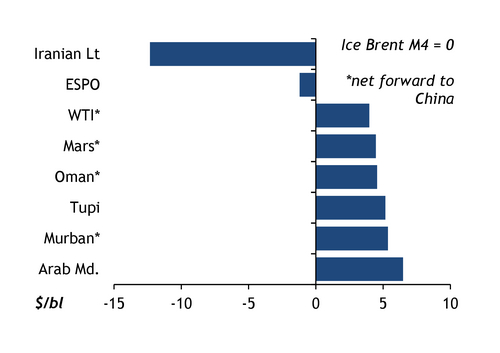
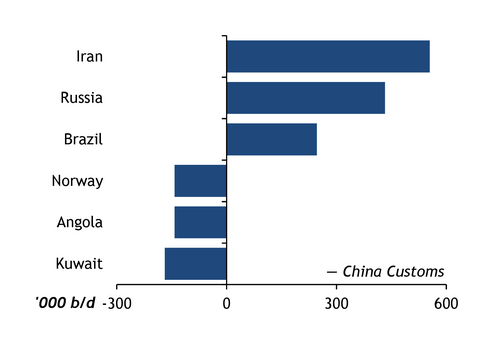
"The US goal is, very simply, to prevent a crisis over Iran's nuclear programme and kick the can down the road, offering limited concessions now in the hopes that broader diplomacy will be possible down the road," Brew says. But the US arsenal of potential incentives for Iran is limited. Any relaxation of oil sanctions runs into bipartisan opposition from the US Congress, and Iran, at any rate, has learned to bypass the sanctions by channelling all its exports to China. Heavily discounted Iranian crude — beating even similarly below-market prices for Russian crude (see charts) — continues to arrive at Chinese ports at a brisk pace.
US requests regarding Iran's nuclear programme, including not enriching uranium to the 90pc level that is considered a threshold for material feeding a nuclear bomb, appear to be acceptable to Tehran, even though external monitoring of compliance by UN nuclear watchdog the IAEA might take time to work out. Broader demands, such as stopping Iran's military aid for Russia's war in Ukraine or de-escalating tanker warfare in the Mideast Gulf — where US and Iranian warships have faced off several times since April — could require a more formal agreement.
"This flurry of developments comprises Washington's ‘Plan C' for Iran — avoid both an escalation and a new agreement with Iran, in the hope that a deal will remain possible after the US presidential elections," think-tank Washington Institute for Near East Policy senior fellow Henry Rome says.
Audacity of hope
Even a limited understanding with the US should be welcome news for Iran's leadership, which is focused on strengthening domestic security in the wake of widespread protests last year over women's rights, and in the face of a coming succession crisis for Iran's ailing Supreme Leader, Ayatollah Ali Khamenei, Brew says. A similar dynamic probably played a role in Iran's detente with Saudi Arabia, which Tehran can cast as evidence of its ability to withstand its continued isolation from the west.
Keeping a fragile ceasefire in Yemen intact has done much to assuage Riyadh's concerns for the security of its oil infrastructure, but moving beyond management of a civil conflict in one corner of the region is unlikely in the near term. "Both nations seem to be in a ‘same bed, different dreams' scenario, with conflicting long-term goals," a regional diplomatic source says. Despite reaching a deal over Yemen, Iran and Saudi Arabia remain apart on regional issues such as Syria, Iraq, Lebanon or maritime security in the Mideast Gulf, the source says.
Years of Iranian intransigence with its Arab neighbours has been a factor in their outreach to Israel — a trend that Washington is now keen to advance by pushing for establishing formal diplomatic ties between Jerusalem and Riyadh. Recent US-Saudi discussions have explored "what was in the realm of the possible" on normalisation, the White House says.
The US is trying to induce Riyadh to take that step by reopening talks on the previously rejected Saudi demands for firmer US defence and arms sales guarantees and for a civilian nuclear co-operation agreement. The two countries are working to arrange a meeting between Biden and Crown Prince Mohammad at next month's G20 summit in India.
The unexpected elevation of normalising Saudi-Israel relations and pursuing an informal deal with Iran to the top of Washington's Middle East agenda shows a drift away from the administration's initial hopes for a reset in its Middle East posture. In that, the White House might be following the same trajectory of former president Barack Obama's administration, whose initial grand regional peace aspirations gave way to a policy, in Obama's words, of "don't do stupid s***".