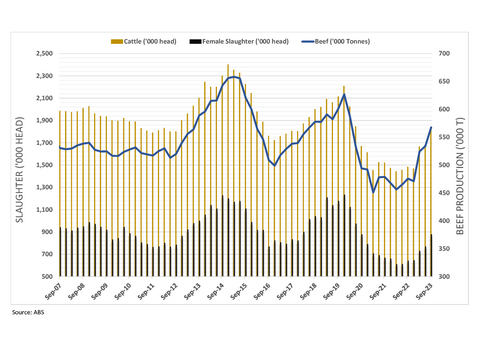
Australia's cattle slaughter rate and beef production increased again during July-September on the back of drier weather that lifted cattle availability.
Cattle slaughter volumes for July-September totalled 1.82mn head, up from 1.68mn the previous quarter, according to Australian Bureau of Statistics (ABS) data. This was the highest cattle slaughter volume for a quarter since the 1.85mn during April-June 2020.
Beef production for July-September totalled 877,200t, up from 767,300t the previous quarter and the highest volume since 586,700t in January-March 2020, according to the ABS.
Female slaughter rates have increased to a herd liquidation state, reaching 48pc for July-September that was up from 45pc the previous quarter. Female slaughter volumes totalled 877,200 head for July-September, up from 767,300 the previous quarter. Female slaughter rates have not been this high since the 973,300 in April-June 2020 when it made up 53pc of total slaughter volumes.
The increase in slaughter rates was largely because of increased turn-off of grass-fed cattle, which increased by 24pc during July-September from the previous quarter to 1.29mn head. Feedlot turn-off also fell by 10pc to 689,000 head. This resulted in grass-fed cattle making up 68pc of the total turn-off for the quarter, the largest portion of the total slaughter volume since 2015, according to Meat & Livestock Australia.
Cattle prices reflected the higher cattle turn-off. The Argus Australian northern cattle feeder price was 411A¢/kg on 5 January but dropped to a low of 222A¢/kg on 26 October with the oversupply of cattle.