


The troubled buildout of Europe's EV supply chain, illustrated by the fall of Northvolt last month, suggests that the future now depends on foreign direct investment (FDI) — particularly from China.
While EV sales in China rose by 46pc last month, they edged down by 2.48pc in Europe, and an increasing share is made up of Chinese-branded battery EVs, as western carmakers struggle to offer affordable models.
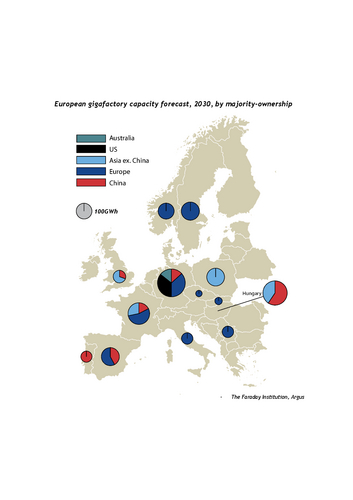
China is now forecast to majority-own 300GWh of Europe's 1.3TWh battery capacity by 2030 (see graph). A shortage of skilled labour, fierce competition weighing on prices for feedstock materials and limited state investment — just some of the problems that befell Northvolt — suggest that Chinese FDI might need to increase further for Europe to expand its EV fleets.
First, FDI into Europe that localises production of EVs that will eventually be sold to European consumers offers jobs to workers and affords Europe a portion of the value added. It offers a chance for technological ‘spillovers' — expertise on how to build and operate Chinese battery machinery in exchange for access to the largest EV market after China.
Europe could also attract Chinese FDI under 50:50 joint ventures (JVs) between Chinese battery makers and domestic carmakers — such as CATL and Stellantis — in order to retain some equity and ensure an integration of local and foreign talent. It is how China developed its own internal combustion engine (Ice) industry, signing JVs with Volkswagen in 1984, Stellantis in 1992, General Motors in 1997 and Toyota in 2000, among others.
It is also not clear to what extent China is comfortable with spillovers in exchange for market access. One criticism is that Chinese FDI might focus on EV assembly, although data from consultancy Rhodium Group show not only China's FDI into battery plants but that this has provided anchoring for FDI upstream into cathode and anode plants in Hungary, Sweden and Finland.
Asian firms tend to hire talent from their home countries for senior positions without "skills trickling down to the local population", according to clean energy researcher Transport & Environment. Chinese firms could continue to make batteries in China, withholding the expertise that eluded Northvolt, before shipping parts for assembly in Europe.
One condition could require a portion of FDI allocated to R&D, involving universities or local think-tanks. "R&D activities are usually not typical features of (Chinese) investments in the V4 [Visegrad] region, as investors usually bring only assembly," economist Agnes Szunomar said in a report on Chinese investments into the V4 in January, although Volvo and Nio have made plans in eastern Europe, Szunomar added.
As it has increased, Chinese FDI — both state and private — has also shifted almost entirely away from mergers and acquisitions towards ‘greenfield' investments (see graph), i.e. businesses from scratch, suggesting a growing skills imbalance between the regions.
European policy must change
Europe is not the only target for Chinese EV-related FDI, and might have to increase its incentives if it is to build out homegrown industry.
In a "carrot and stick" approach, endorsed by InoBat chairman Andy Palmer, the efficacy of the EU's much-deliberated tariffs as a ‘stick' appears uncertain so far.
Analysis from Rhodium Group suggests that the EU's tariffs have disproportionately penalised western-branded EVs made in China and sold in Europe. They have also been too weak to entirely force China's EV production into Europe and yet strong enough to raise investor uncertainty, which could include further hikes on EVs or new tariffs on battery materials, for instance, which would scupper China's plans for FDI in battery assembly.
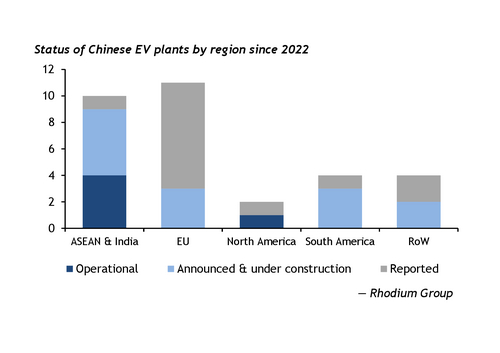
Out of 11 EV plants that China is reported to have considered, just three in Europe have been confirmed (see graph) — the lowest share globally of China's investments.
Meanwhile, tax breaks, grants and interest-free loans might fulfil the ‘carrot' in the EU's approach, as Hungary has illustrated, with state support for multiple projects, ranging from €2.4mn to €900mn for CATL's $7.3bn battery plant announced in August 2022 — set to create 9,000 jobs — and consequently 61pc of Chinese FDI into Europe last year, according to analysis from Rhodium Group (see graph).
19122024043837.jpg)
19122024043812.jpg)


