Freight rates for barges carrying oil products on the Rhine have hit an all time high because low water levels have left the river's Kaub bottleneck practically impassable and have rendered limited shallow draft barge resupply uneconomical.
At the start of the week, the Kaub bottleneck on the Rhine fell below the critical 30cm mark, making the route impassable for most inland barges. Shipowners said only a few specialised vessels with shallow drafts can still pass, but these are typically tied to long-term charter agreements and crews require considerable experience and detailed knowledge of the shoals around Kaub to navigate safely.
The Upper Rhine and Main River are now practically cut off from the Amsterdam-Rotterdam-Antwerp (ARA) trading hub. The same is true for Switzerland, which heavily relies on imports of oil products from ARA via the Rhine.
Problems may soon extend to the Lower Rhine. Barge loading operations are at risk of being suspended at the beginning of the week ending 7 August, as a result of extremely low water levels.
The water level at Duisburg is forecast to reach a historic low by the end of the current week, which would make vessel loading impossible and potentially cut the direct route from ARA to the 251,000 b/d Gelsenkirchen refinery.
Barges transporting oil products or blending components to and from the refinery switch from the Rhine to the Ruhr River at Duisburg, then reach Gelsenkirchen via the Rhine-Herne Canal. If water levels at Duisburg fall as expected, loading restrictions will make such shipments uneconomical or impossible, traders said.
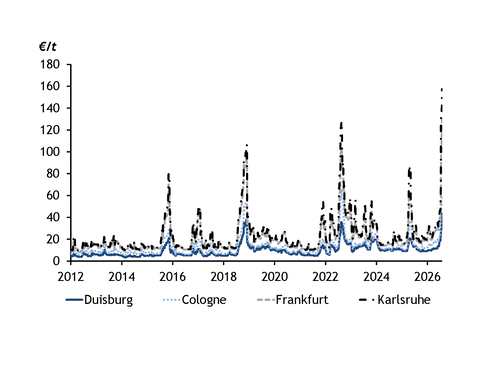
Shipowners have been raising freight rates for shipments from ARA to destinations along the Rhine and Main since mid-June, with the pace of increases accelerating in the second week of July. Freight rates to Duisburg, Frankfurt and Karlsruhe have now reached record highs since assessments were launched in 2012 (see chart). Only rates to Cologne and Basel were higher once before, in August 2022, when low Rhine water levels coincided with maintenance at the Gelsenkirchen refinery and production issues at Austria's 193,700 b/d Schwechat refinery.
When barge resupply and outbound shipments become difficult or impossible, rail transport appears to be an alternative. But traders and shipowners said there is very little spare capacity for additional rail shipments. Many market participants are seeking alternatives to barge transport at the same time, further tightening rail availability.
Price gaps
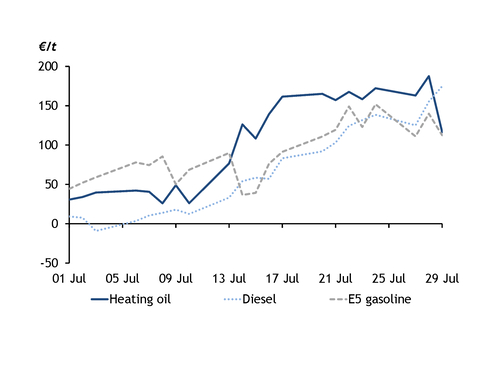
Severe disruption to resupply logistics and higher freight rates are causing price increases at import hubs in western Germany compared with refinery locations. Suppliers at the 310,000 b/d Miro refinery in Karlsruhe can no longer ship relevant volumes of surplus product by barge to other destinations or ARA. As a result, they are lowering prices for truck loadings of heating oil, diesel and gasoline to reduce excess inventories.
The disconnect between import and refinery markets has reached almost unprecedented levels. Heating oil, diesel and gasoline in the Rhine-Main region are trading way above prices at Miro (see chart).
Gasoline is increasingly difficult to source on the spot market in Rhine-Main, the Cologne region and western Germany. Many suppliers have withdrawn from the spot market, likely because low water levels are preventing adequate supplies of blending components, making normal gasoline production impossible.