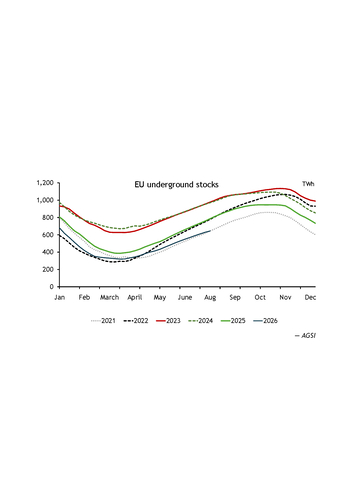
The EU entered August with gas stocks reaching at least a 16-year low in percentage terms, raising the risk that the bloc will start winter with reserves at an all-time low unless injections rise significantly.
EU-wide storage levels in percentage terms dipped below those in 2021 on 1 August, resulting in the lowest fill level for that date since 2011 when the GIE transparency platform started collecting data. Aggregate reserves filled 57.1pc of capacity as of Sunday morning and were at a 0.2 percentage point deficit to 57.3pc on the same date in 2021, GIE data show. This is also well below the five-year average of 73.5pc.
That said, in absolute terms, EU facilities held 645.4TWh on the morning of 2 August, at a six-year low for that day, but slightly up from 641.6TWh on that date in 2021 owing to an increase in technical storage capacity.
Mild weather in April curbed European demand and allowed for a strong start to the stockbuild, but net injections since May have consistently lagged behind previous years, eroding an initial surplus to 2021(see graph). Firms net injected 1.75 TWh/d in April, reversing 47 GWh/d net withdrawals in 2021 and up 22pc from the 1.43 TWh/d five-year average. Net injections in May-July averaged 2.97 TWh/d, 10pc below 3.3 TWh/d in 2021 and 14pc below the five-year average of 3.47 TWh/d.
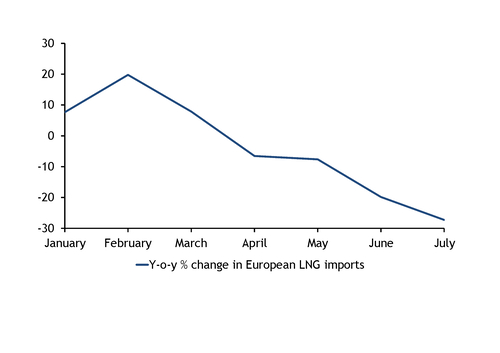
Disruptions to LNG exports from the Mideast Gulf remain the dominant factor curtailing injections. The effective closure of the strait of Hormuz at the end of February began to reduce LNG deliveries to Europe at the end of March, given the one-month transit via the Cape of Good Hope.
Since then, European LNG receipts have been down on the year for every month over April-July, with the deficit widening with each consecutive month as Asian cooling demand rose and drew increasingly more cargoes away from Europe. Kpler ship-tracking data show that imports fell by 7pc, 8pc, 20pc and 27pc year on year in April, May, June and July, respectively (see graph).
LNG deliveries totalled 30.46mn t in April-July, down from 35.8mn t a year earlier. The 5.34mn t deficit equates to 81.7TWh of gas that firms could not inject into storage since 1 April.
And Mideast Gulf exports are unlikely to normalise before the end of the injection season after US-Iran tensions re-escalated in mid-July. If this is the case, Europe may not be able to compensate for its slow stockbuild so far and could enter winter with its lowest stocks on record.
Stocks on 1 November were at their lowest in 2021 in percentage terms when facilities were filled to 77pc of capacity. To match or surpass this level, firms would have to inject at least 2.49 TWh/d until 1 November — well above the five-year average of 2.07 TWh/d for 3 August-31 October. And even 77pc would still fall short of the minimum EU state-by-state requirement of 80pc, which already reflects a 10 percentage point deviation from the original 90pc goal. That said, the EU target can be met during at any moment during 1 October-1 December.