Traders have started factoring possible strait of Hormuz supply disruption into January and February gas prices, as record-low stocks and a prolonged US–Iran conflict could tighten supply well into winter.
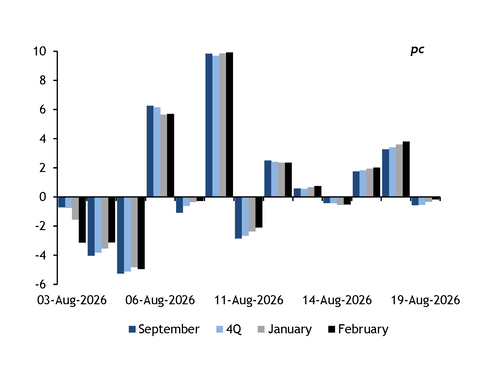
The TTF January and February contracts posted on average the largest gains and smallest losses over the past 10 sessions (see graph), as traders deemed a normalisation of Hormuz traffic increasingly unlikely. TTF January and February prices climbed by an average of 2.05pc and 2.15pc day on day, respectively, over the past 10 sessions. This outpaced the front-month increase of 1.93pc and the fourth-quarter 2026 rise of 1.98pc.
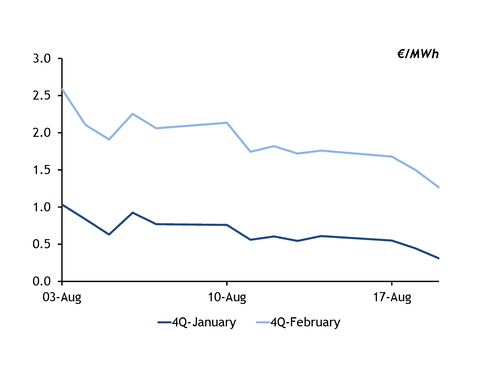
Both contracts remain at a discount to August-December prices, but narrowing discounts suggest traders expect similar supply risk in those months. Market participants polled by Argus highlighted peak heating demand, depleted stocks and maintenance at Norway's Ormen Lange field — expected to run until 1 February — as supporting January-February prices more than near-term values, where supply risk looks less severe.
The market consensus is that QatarEnergy could ramp up the now-64.2mn t/yr Ras Laffan export terminal within two months. And a June report stated Qatari LNG production could reach half of Ras Laffan's 77mn t/yr nameplate capacity in just one month.
Europe could also face depleted storage sites in midwinter. Tight global supply has diverted LNG to Asia to meet summer cooling demand. But hot weather in Europe has boosted gas burn for power, slowing the stockbuild.
January and February typically record the strongest gas withdrawals, mainly in northwest Europe, as heating demand peaks. Combined net withdrawals in France, Germany, the Netherlands, Belgium and Denmark averaged 3.15 TWh/d in January–February 2024-26, above the winter averages of 1.7 TWh/d. Underground inventories in northwest Europe held 274TWh on Wednesday morning — the lowest on record for the date and at a 177TWh deficit to the three-year average.
Without a faster build, northwest Europe may enter 2027 with record-low inventories, raising supply risk for those months. Gains in the contracts may reflect greater competition for supply over that period.
THE follows, increasing storage incentives
THE prices showed a similar trend, except traders have sold off near-term contracts while bidding higher for January and February markets.
This has restored the incentive to book storage, but reduced the appeal of sending gas to Germany in the coming months.
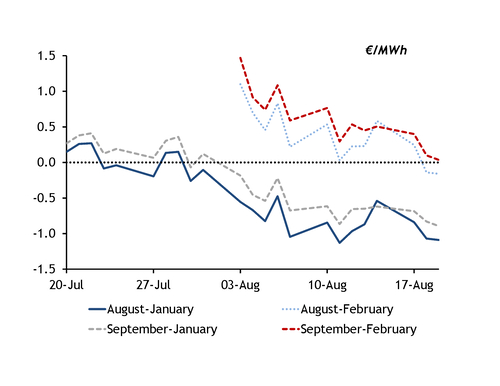
THE January and February contracts have risen more than near-term prices, mirroring TTF moves, and now hold a premium to the THE August price. This premium has widened recently, restoring an economic incentive to book storage space. Sefe's successful allocation of 5TWh at its Rehden site underscores this, even though the product was offered at a discount to previous similar sales.
The THE August price was at a €1.09/MWh discount to January and a €0.16/MWh discount to February at the latest close. But THE balance-of-month and front-month prices have held at a small premium or a discount to other European hubs in recent days. Market participants can still lock in profitable spreads to inject this month and withdraw in January, but if THE remains uncompetitive, firms may divert gas elsewhere, tightening the domestic balance. Some Norwegian exporters have already rerouted gas to the Netherlands because the THE–TTF everyday basis market has narrowed.
German storage sites were 50pc full on Wednesday morning, at an 87TWh deficit to the three-year average and 49TWh below the 70pc target for 1 November. Injections must average 670 GWh/d for Germany to hit its target, well above the 251 GWh/d three-year average.