The move comes in response to tightening diesel markets and a rapid run-up in prices, particularly in the US, writes James Keates
The G7 will immediately begin a four-month release of 100mn bl of oil stocks, with a substantial diesel release within 20 days, it said on 2 October.
The group asked the IEA to monitor the "immediate and full implementation" of stock release commitments made in March. This indicates that the 100mn bl is a portion of these commitments, rather than an extra pledge.
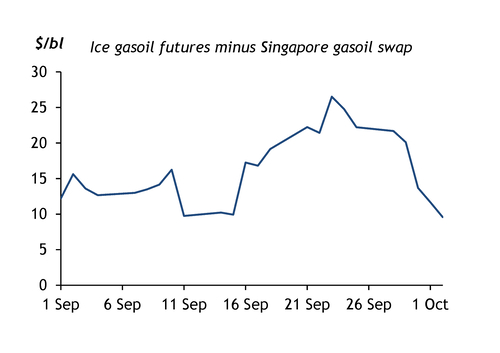
The move comes in response to increasing concerns about European diesel supply and pressure on US president Donald Trump to restrict or even ban exports of the diesel on which Europe has become reliant. European diesel prices dropped sharply relative to prices in Asia-Pacific in response to the prospect of a "front-loaded" oil inventory release by G7 members (see graph). The G7 statement does not specify the amount of diesel or how the 100mn bl will be divided between crude and products.
Europe has become increasingly dependent on US diesel since Mideast Gulf flows were constrained by the near closure of the strait of Hormuz and after Russia halted diesel exports. The EU, the UK and Norway received 430,000 b/d of US diesel and other gasoil in August, according to Kpler. US supplies have accounted for around 40pc of the region's diesel and gasoil imports on average this year. Any US export ban would intensify competition between Europe, Latin America and other importing regions for alternative supplies.
A number of market participants have questioned whether a full US ban would be sustainable. Excess diesel would accumulate in the US, potentially forcing refiners to cut crude runs and reducing domestic gasoline production. The G7 statement also addresses the possibility of a US diesel export ban. Members pledged not to restrict trade in energy and energy products between G7 countries and called on other producers to avoid bans that could exacerbate market tensions. Such a ban would undermine its trust in the US as a reliable partner, the European Commission said on 2 October.
G7 members will meet through the IEA in the coming days to discuss additional diesel releases if needed. They will also co-ordinate refinery maintenance schedules to avoid simultaneous shutdowns and temporarily raise refinery utilisation where possible, and will encourage countries with significant refining capacity to increase production of refined products, particularly diesel.
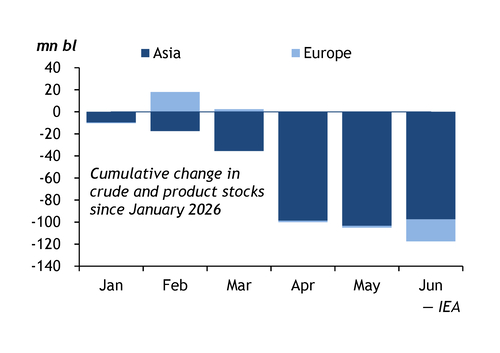
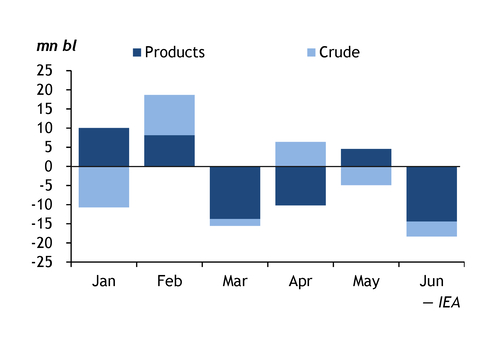
IEA members agreed in March to make 400mn bl of oil available from their emergency reserves in response to the supply disruptions stemming from the war in the Middle East. The IEA subsequently put members' planned contributions at 426mn bl, comprising just over 300mn bl of crude and 125mn bl of products. Europe appears to have released very little of this during the initial Hormuz shock of March-June, IEA data show (see graph). OECD Asia — South Korea and Japan — released an initial 72mn bl of crude in April but even their stocks had begun to build again by June.
Monitor wizard
EU diesel supplies are stable for now, although prices are high because of tight global markets, the commission said. The IEA will monitor the effect of the stocks release and other supply measures on energy security and market stability and report within 20 days. Its report will include recommendations on further action, including replenishing emergency stocks, the G7 said. The G7 also addressed the wider conflicts behind the disruption to energy markets. It condemned Iran's attacks on neighbouring countries, called for the immediate restoration of navigational rights through the strait of Hormuz and pledged to maintain sanctions against Russia.