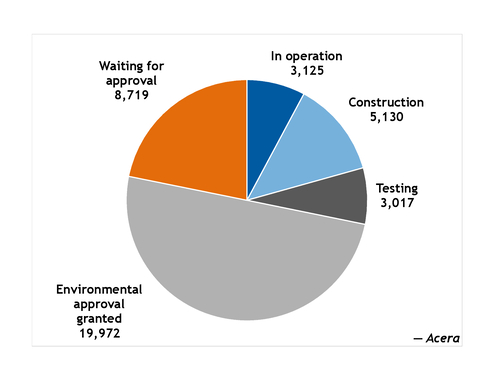
Chile's battery energy storage system (Bess) capacity is soaring to support the high penetration of lower-cost solar power, but may become a victim of its own success as expanding supply shrinks revenues.
"Chile has shown that batteries work. Now, it must show it knows how to value them," Ana Lia Rojas, director of storage and renewables association Acera, said at the Future Energy Summit in Santiago last week.
Bess development in operation, testing or construction has jumped to 11.2GW from 84MW in 2023, mainly in sunny northern Chile close to solar plants, she said.
Of this, 6.1GW has started commercial operations or has connected to the grid and is dispatching electricity and testing its installations as part of national grid coordinator Cen's approval process. The other 5.1GW is under construction.
Acera expects operating Bess to reach 10GW in the first half of 2028, with an average duration of 4.4 hours of dispatch for each installation. Chile's total generation capacity is 40GW.
Bess is already displacing thermal generation and providing grid security, said Rojas.
It is participating in "ramp-ups", when thermal plants usually come on line to handle the combined surge in demand and drop in supply as the sun goes down. It is now supplying 80pc of peak demand — 6-10pm local time — compared with 1pc in 2023.
In 2026, Bess has displaced 2.3TWh of thermal generation, she said.
The technology also provides around half of secondary frequency controls and a growing share of primary frequency controls that protect against grid fluctuations, according to Rojas.
New regulations, approved in January, will require most solar, wind and Bess plants to adopt grid-forming technology which, subject to design, should be able to also provide voltage controls and "black starts", or restarts after an outage.
Bess is also storing curtailed solar power when plants must go off line due to insufficient demand or transmission capacity. August was the first month since 2017 that accumulated curtailment was lower than the same month of the previous year, said Rojas.
As of 3 November, Chile's solar curtailment of 3.1TWh in 2026 was 8.5pc lower than a year earlier, according to Cen data.
Bess took off in 2024 when Chile approved a regulation to remunerate the technology's capacity to supply electricity at peak times — in line with other power plants.
It also obtains energy arbitrage revenues calculated according to the price difference — or spread — between buying and selling electricity at the time of charging and discharging respectively.
Economic returns
As Bess installed capacity expands, both these revenue sources will diminish, said Alfredo Solar, regional manager for Chile and the Southern Cone at Latam-focused utility Atlas Renewable Energy.
"It is beginning to cannibalize," he said in a panel discussion. Investors need power purchase agreements (PPAs) to ensure stable revenues, he said. Atlas has PPAs for all its 2GW of hybrid solar-Bess projects in Chile.
Nor does energy arbitrage adequately pay Bess yet because it uses the real-time marginal cost for discharging electricity, which is the same as the charging marginal cost of close to $0/MWh during the day when the sun is high.
The industry is anxious for the authorities to implement the opportunity cost for Bess in arbitrage payments, which would reflect the difference between charging cheaply during the day and displacing more costly thermal generation at night. There is a deadline to implement the opportunity cost by June 2028.
The Cen is also expected to update ancillary services shortly and enable Bess to be paid for providing grid security attributes such as ramp-ups and voltage controls.
Bess is vital to meet Chile's energy transition goals for 80pc of electricity to be renewable by 2030 and 100pc by 2050.