

Chlor‑alkali market tightens on Mideast conflict
The conflict in the Middle East and disruption in the strait of Hormuz have unsettled key markets, sending ripple effects through the chlor-alkali and vinyls value chains across much of Asia.
Supply disruptions of LNG and naphtha from the Middle East to Asian countries have severely increased market volatility and uncertainty. While the direct exposure to the chlor-alkali market is limited, but indirect pressure is getting adverse.
The Middle East accounts for only about 3pc of global caustic soda capacity, so the direct impact of regional supply losses is minimal. But as tensions escalated, alumina refineries and chlor-alkali producers scaled down operations. Alumina refineries such as Ma’aden and EGA are securing caustic supply within the region from producers in Saudi Arabia and Qatar.

Middle caustic, alumina, PVC capacity country-wise versus pc of the respective global capacity.
For context, regional demand rose by 7pc in 2025, while supply stayed stable. Middle East exports in 2025 fell compared with the previous year, despite steady supply. Most exports went to Africa, Australia, and south Asia. Imports from China and India increased in 2025, according to data from Global Trade Tracker and Kpler.
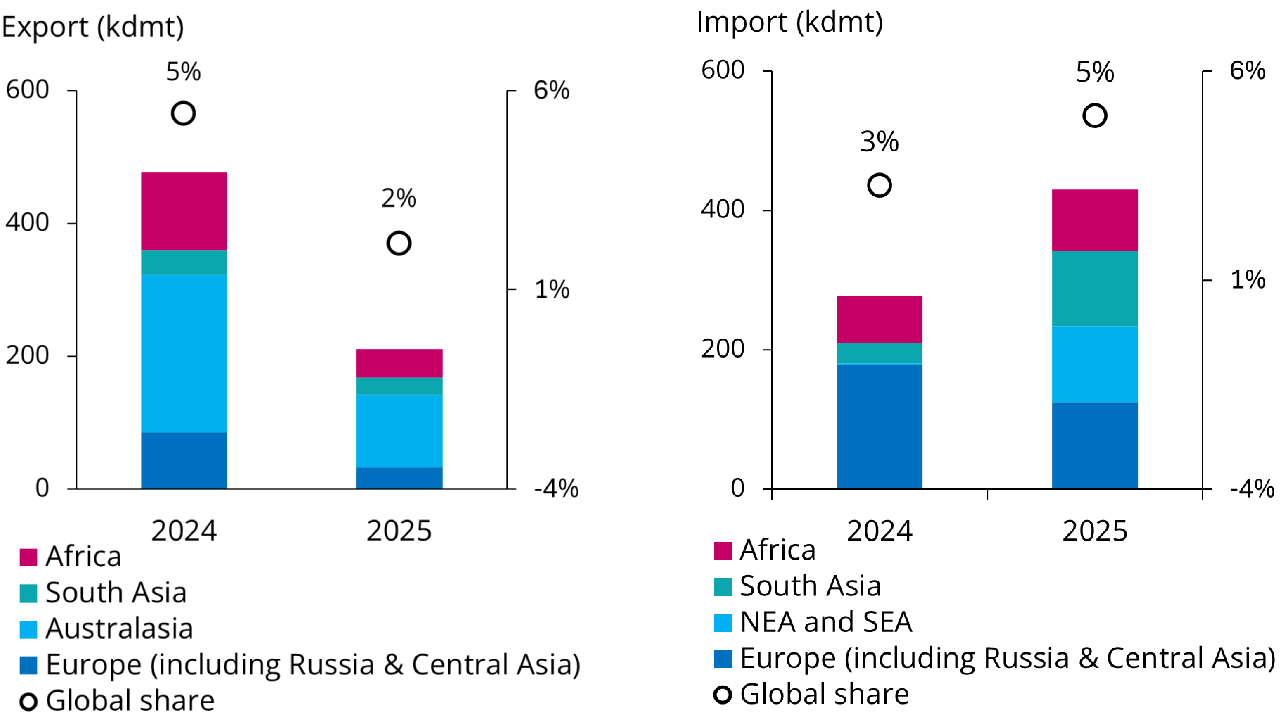
Middle East Caustic Soda export and import exposure region-wise versus global export share.
Indirect impacts are mounting: caustic soda fob and cfr prices are rising rapidly, with cfr values climbing faster because of higher freight costs driven by rising fuel prices and bunker surcharges.
The main squeeze comes from chlor-alkali operating rates, which heavily rely on chlorine offtake, mainly within the vinyl chain. Coastal Chinese chlor-vinyl producers, many of which are ethylene-based, have experienced moderate impacts, leading them to scale down since China is not solely dependent on naphtha for ethylene demand. Meanwhile, around 70pc of China’s vinyl capacity is carbide-based and remains largely unaffected, continuing at normal or even higher run rates.
In contrast, northeast Asian countries, excluding China, have been severely impacted as they rely on naphtha for ethylene. Several vinyl producers in northeast Asia have declared force majeure, as have few in southeast Asia.
Despite this, China’s average chlor-alkali operating rate has only dropped slightly and remains high at 83-84pc, while Japan, South Korea and Taiwan are running at about 60-70pc. There has been no official announcement of force majeure, and producers are relying on attractive netbacks from caustic soda.
The caustic soda supply shortfall has triggered short covering, resulting in significantly higher caustic soda prices in recent weeks. Disruptions in Middle Eastern naphtha flows have also created feedstock shortages and cost pressure for vinyl producers. This has reinforced operating rate cutbacks in northeast Asia outside China and in southeast Asia, amplifying PVC tightness and reducing chlor-alkali operating rates, which is reducing caustic availability.
Unlike caustic soda, the PVC market is deeply exposed to Middle East trade flows. This is not only limited to ethylene feedstock availability and PVC exports but also trickles down to PVC intermediates such as VCM and EDC exports. Prices had already begun rising before the crisis, improving netbacks for vinyl producers, and creating upward momentum in caustic soda prices.
If the conflict continues, more vinyl producers will be forced to cut rates, and PVC prices will keep rising as logistics and feedstock constraints intensify. Chlor-alkali operating rates would fall further, tightening caustic supply across the region.
This blog has been created using data and analysis from the Argus Chlor-Alkali Outlook and Argus Chlor-Alkali Analytics services. Learn more.
Author name: Anshu Pandey, Business Analyst, Chemicals
Related products
Spotlight content


Speak to our experts today


