

Epic Fury fires global jet prices to new heights
Market turmoil resulting from US and Israeli war with Iran has caused commodities prices to surge across the board as more than 10mn b/d of liquids production has been removed from the market, but jet fuel has ‘taken off’ from the rest of the barrel. Key price movements since 27 February (the day before the attack):
- WTI crude oil has increased by $29.19/bl, or 43.6%, to $96.21/bl as of 17 March, after peaking a few days earlier at $98.71/bl — its highest since July 2022.
- North Sea Dated crude climbed by $31.85/bl — a roughly 45% hike — to top the $100/bl mark for the first time since November 2022.
- Dubai oil has more than doubled in the days since the first attack to a record high at more than $150/bl — surpassing the previous high set in 2008 by 7%.
If we look at jet fuel, specifically:
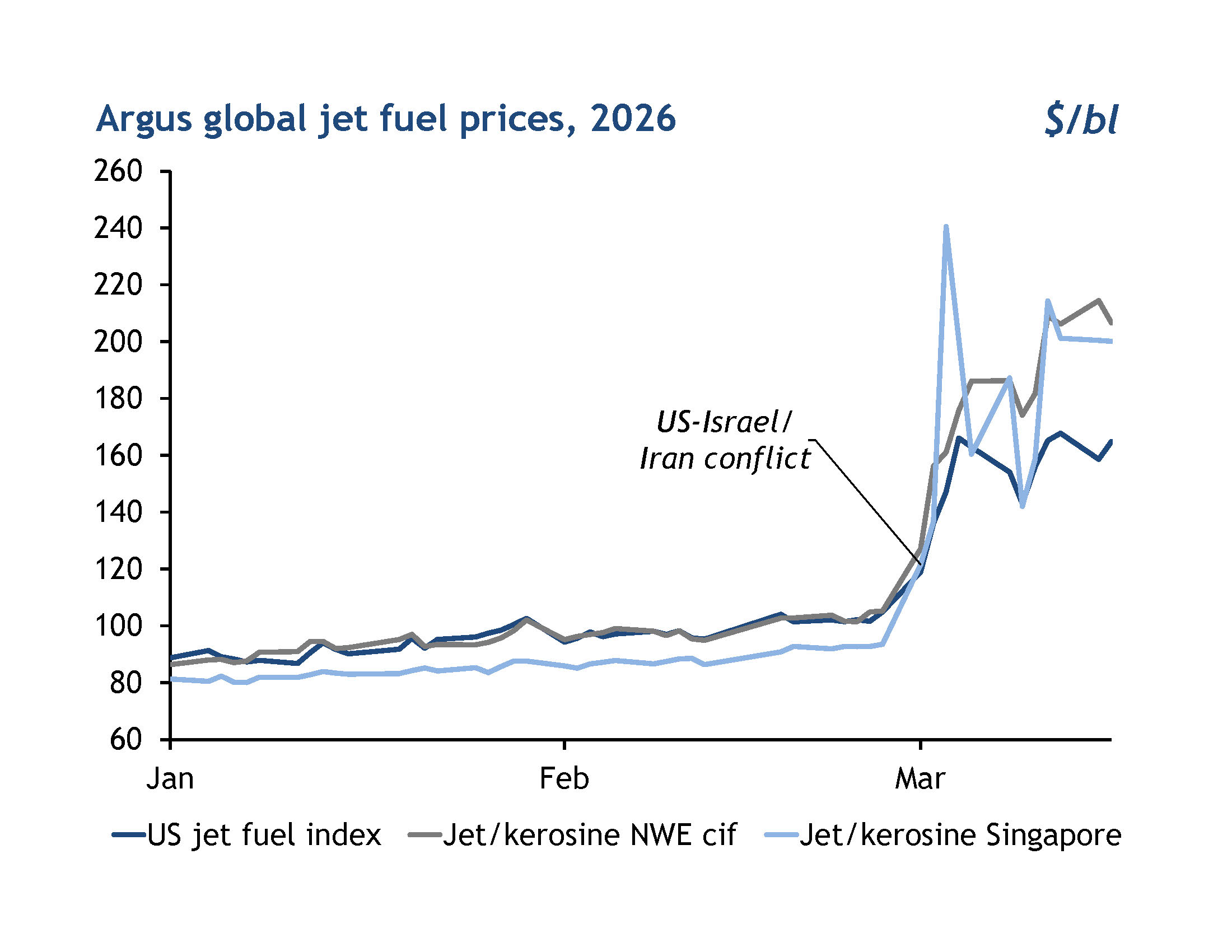
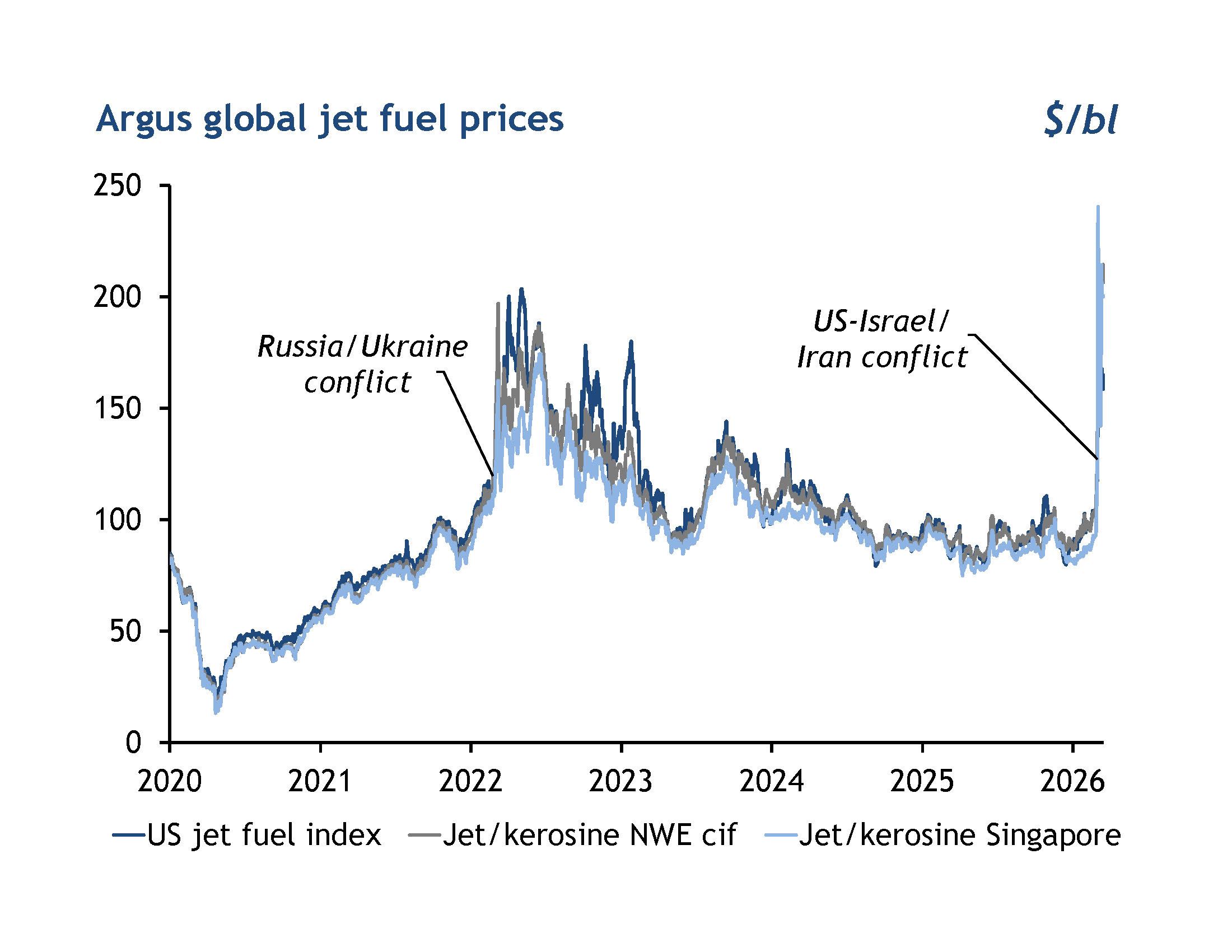
- Delivered prices to Northwest Europe have all but doubled since the war began – climbing by roughly $800/t, or more than $100/bl, to an all-time high over $1,600/t ($210/bl). The previous high was set in the 2022 energy crisis after conflict began in Ukraine.
- The average US jet fuel price rose by roughly $60/bl, or 60%, in the days following the initial attack to peak at $167.75/bl on 13 March, its highest since January 2023.
- Jet/kerosine in Singapore has climbed by 114% to more than $200/bl, peaking 4 March at an all-time high of $240.50/bl.
So why has jet fuel been so unevenly influenced compared to other commodities?
First, the average barrel of oil yields 19-20 gallons of gasoline, 11-13 gallons of diesel and heating oil but just 3-4 gallons of jet fuel. The more limited a product is, the more vulnerable its price is to supply shocks like we are seeing with the de facto closure of the strait of Hormuz.
At this time last year, international oil production hovered around 83mn b/d, gasoline production was roughly 26.7mn b/d, diesel and gasoil production was 30mn b/d and jet-kerosene production was just shy of 8mn b/d, according to Kpler analytics. Roughly 1.8mn b/d of jet fuel was being exported worldwide, and 24% was being delivered via the strait of Hormuz. Since the beginning of March, global jet exports are down more than 60% to less than 700,000 b/d as the war in Iran is met by some governments shutting off products exports altogether for fear of a shortage in crude feedstocks.
The Mideast Gulf alone accounts for more than half of jet fuel imports into Europe, where the oil sector has slowly been cutting refining capacity over the years, making it increasingly reliant on imports. Independent stock levels at the Antwerp-Rotterdam-Amsterdam (ARA) hub are so far only 8% lower on the year as of 11 March, but market participants expect European jet supply to significantly tighten by April if security concerns surrounding Hormuz shipments remain.
European refiners are not shortening or delaying spring maintenance despite the surge in refined product cracks following the start of the war, according to market participants. Many service providers have already been paid, and cancelling or rescheduling work would carry costs that could outweigh any gains from stronger margins.
Several vessels carrying fuel for Europe have meanwhile reversed course for Asia, where concerns are mounting over deep refinery run cuts. A Singapore refinery is reducing its run rates from around 85% to 60%, owing to crude supply disruptions from the Middle East. In Japan, a refiner cancelled an end-March loading gasoline cargo, and confirmed privately they have cut runs by 10%. Thailand’s energy ministry has halted all oil exports in anticipation of a domestic shortage, following a similar move by China’s top regulator advising firms against shipping gasoline, diesel and jet fuel overseas without a special reason.
Chinese refiners previously planned to increase jet fuel exports by 40,000 b/d this month to 650,000 b/d, but preliminary data from analytics firm Vortexa suggests just 155,000 b/d was loaded the first week of the month — less than half of what was anticipated over the same period. State-owned refiners take up to half of their crude purchases from the Middle East, leaving major exporters like Sinopec and PetroChina exposed to oil supply disruptions. Sinochem is planning to cut runs at its 300,000 b/d Quangzhou refinery in Fujian, while private-sector mega refiner Rongsheng is already on course to cut runs at its 800,000 b/d refinery by 20 percentage points more than a month ahead of schedule.
European buyers have also been avoiding India’s Reliance because of its Russian crude purchases — cutting off the region’s second-biggest source of jet fuel. The remaining options are Nigeria’s 650,000 b/d Dangote refinery and the US Gulf coast, which usually ships the large majority of its exports to Latin America or the US Atlantic coast. Export prices have been trending higher since the start of the war, though, and the US Gulf coast jet fuel benchmark has increased in value by more than 70% to its highest since mid-2022.
In mid-March, the Energy Information Administration raised its 2026 jet fuel forecast by 37% to $2.67/USG while also increasing its production forecast by 4.5% to 1.83mn b/d after recent investments to boost jet fuel capacity, taking advantage of stronger margins.
The US territory most vulnerable to volatility is at the west coast, which had already been in a transitionary period with the shut-down (completed and near-completed) of two refineries in the past six months. Phillips 66 ceased production at its 139,000 b/d Los Angeles refining complex by the end of 2025, and Valero is set to idle process units at its 150,000 b/d Benicia refinery by next month. Combined, the two refineries represented roughly 17% of California’s crude processing capacity, which has added a layer of volatility to the region if there are any other supply upsets.
The west coast is quite reliant on imports from South Korea, which supplied 85% of total US jet fuel imports last month and 87% of imports to the west coast last year. Regional jet prices jumped to a fresh 44-month high on 17 March after South Korea announced a mandatory cap on exports of refined petroleum products, limiting shipments to 2025’s monthly levels in an effort to safeguard domestic supply. The cap indicates South Korea has little room to supplement US west coast supply after the refinery shutdowns. And if South Korea were to start diverting cargoes to fill demand left by restricted Chinese jet fuel exports, this could exacerbate prices at the US west coast.
Stay up to date with Argus
The trusted source of global jet fuel market analysis, Argus Jet Fuel is the only service compiling all global jet fuel prices into one place. With benchmarks for both jet fuel and sustainable aviation fuel (SAF), this report is used and trusted by companies throughout the supply chain and around the world. Learn more about this service.
Middle East war conflict
For the latest news and insights from our teams into how this conflict is impacting the global energy and commodity markets, visit our topical hub.
Author name: Amanda Hilow, global jet fuel and US distillates editor


