
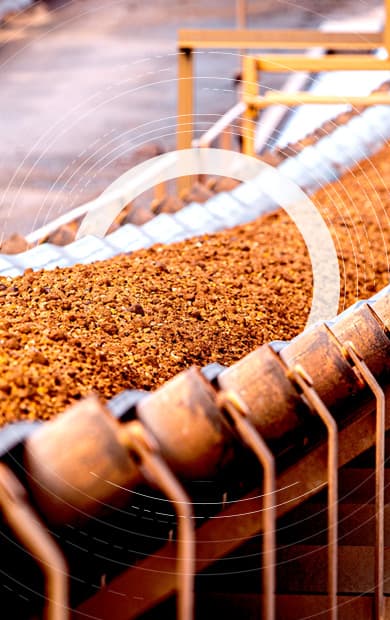
Steel raw materials
Overview
Argus’ comprehensive coverage of the global ferrous markets provide independent price assessments, news and market analysis for iron ore, coking coal, ferrous scrap, pig iron and steel.
Our global team of experts in China, Singapore, the UK and US deliver over 300 domestic and seaborne price assessments along with detailed market commentary on a daily basis to ensure our clients have complete mine to mill price coverage.
The ferrous portfolio includes established Argus price indices for 62pc and 65pc iron ore fines, Turkish ferrous scrap imports, and our fob Australia and cfr China premium hard coking coal indices.

Stay ahead of the ferrous metal markets
To be informed of relevant content, sign up to Argus Ferrous Market Highlights. Each newsletter issue provides key prices, selected news, downloadable insight papers, podcasts, and on-demand videos across the global ferrous markets. Our coverage spans steelmaking raw material markets, including coking coal and iron ore, steel markets, including flat, long and semi-finished, as well as line pipe and OCTG markets.
Sign up nowLatest steel raw materials news
Browse the latest market moving news on the steel raw materials industry
India to build first chip fabrication plant in Dholera
India to build first chip fabrication plant in Dholera
Mumbai, 17 April (Argus) — India approved the country's first semiconductor fabrication plant to be developed by Tata Semiconductor Manufacturing at Dholera in Gujarat as part of a special economic zone, the Indian government said on 16 April. The project, which will span 66.2 hectares (ha) (662,000m²), is designed to support high-value, capital-intensive semiconductor manufacturing and related industries, focusing on electronic hardware, software, and IT-enabled services. The special economic zone will feature enabling infrastructure, streamlined logistics and a dedicated approval process to accelerate operations. Further details, including construction timelines, were not disclosed. The board of approval for special economic zones also approved major projects in 2025 , including Micron Semiconductor Technology's facility at Sanand in Gujarat and Aequs Group's electronic component manufacturing special economic zone at Dharwad in Karnataka. These projects aim to strengthen the country's semiconductor and electronics ecosystem by bolstering domestic value chains and reducing reliance on imports. By Deepika Singh Send comments and request more information at feedback@argusmedia.com Copyright © 2026. Argus Media group . All rights reserved.
Iran war prompts shift to fob steel export offers
Iran war prompts shift to fob steel export offers
London, 16 April (Argus) — Steelmakers in major exporting countries are switching from cost and freight (cfr) to free on board (fob) offers as the US-Israel war with Iran pushes up ocean freight and disrupts shipping routes. Many Asian and Turkish mills are reluctant to offer flat steel on a cfr basis because uncertain delivery times and higher freight costs threaten margins, industry participants said. Offers on fob terms — which make the buyer responsible for all costs after the goods are loaded at the port of departure — are now increasingly common, buyers in the Middle East and Europe said. "I think all exporting mills are scared to offer cfr in the Middle East. They will probably be okay with fob, and even that with caution," a UAE-based importer said. The strait of Hormuz remains effectively closed, with no clear resolution in sight after US-Iran peace talks failed over the weekend of 11-12 April. Sellers have been exploring alternative routes, such as shipping material to the Jeddah in Saudi Arabia or Sohar in Oman ports and then transporting it to the UAE and other markets by road, sources said, but volumes remained limited because of elevated freight costs and uncertain transit times. Indian hot-rolled coil (HRC) offers to the Gulf Co-operation Council (GCC) region were suspended after the war began at the end of February. An Indian mill was forced to postpone its March shipments to the region because of the war. It has now converted some prior bookings to fob from cfr, making the buyer responsible for transportation to the destination market. India's finished steel exports to the GCC region accounted for about 12pc of its overall steel exports over the past 11 months, government data show. GCC domestic flat steel prices have also risen as imports slowed and raw material supply was disrupted. Saudi producer Hadeed increased HRC offers for June shipment, while a major UAE galvanised coil producer was heard facing supply disruption that limited export availability and reduced spot sales to the domestic market, traders said. In the European import market, challenges in fixing freight rates and uncertainty surrounding margins have also prompted a move to fob offers. An Indian mill said it was scaling back HRC exports to Europe because of a sharp rise in shipping costs. Freight rates from India to Europe for volumes of 25,000-40,000t have risen to about $80/t or more, from $50-60/t earlier. The mill has also cautioned its European buyers that delivery of cargoes booked in January and February was likely to be delayed owing to vessel shortages. By Amruta Khandekar and Elif Eyuboglu Send comments and request more information at feedback@argusmedia.com Copyright © 2026. Argus Media group . All rights reserved.
Energy relief to support S African FeCr in short term
Energy relief to support S African FeCr in short term
London, 16 April (Argus) — South African energy tariff relief may not save South Africa's ferro-chrome sector in the long-term but will support production in the short term and put pressure on Chinese competitors, market participants at the International Chromium Development Conference in Zimbabwe said over 15-16 April. South African state-owned energy provider Eskom announced on 10 April that it had submitted an energy tariff relief structure of 62 South African cents/kWh ($0.04/kWh) to South African energy regulation Nersa after extensive talks with the government and South African ferro-chrome producers Samancor and the Glencore-Merafe Chrome joint venture (JV). This tariff is more than half the 135.82 cents/kWh ferro-chrome producers were paying at the end of 2025. The tariff relief came after Samancor and Glencore-Merafe sharply cut production in 2025 because of low profitability. The Glencore-Merafe JV's ferro-chrome production fell 63pc on the year in 2025 after Glencore-Merafe suspended operations at the Wonderkop and Boshoek ferro-chrome smelters in May. South Africa is a major global charge chrome producer, although it has struggled in recent years to compete with lower-cost ferro-chrome produced in China's Inner Mongolia region. Chinese ferro-chrome producers benefit from lower energy prices than their South African counterparts. The rise in Chinese ferro-chrome production pressured global ferro-chrome prices too low to support profitability for South African ferro-chrome producers at their old energy costs. Argus assessed high-carbon ferro-chrome 50pc cr at $1.00-1.01/lb ex-works China on 14 April, up 31pc from the start of 2025 but well below prices in 2021-22. For South African ferro-chrome producers, selling chrome ore has been more profitable than producing ferro-chrome in South Africa in recent years. South African UG2 concentrate 40-42pc cr203 prices rose 56pc from the start of 2025 to $310-320/t cif China main ports on 14 April. Energy relief may be unaffordable In conversations on the sidelines of the conference, market participants expressed doubts about the long-term prospects of South Africa's ferro-chrome production. Multiple senior-level figures said they did not view the new tariff agreement as financially feasible on the part of the government, and that even if it led to short-term increases in production, the government will not be able to meet its commitments over the full five years. The cost of production for electricity from coal is around 80 South African cents/hr, well above the new energy tariff at 62 cents/kWh. Bongani Motsa, senior economist at the Minerals Council of South Africa, agreed that the government cannot afford the deal, but argued that at the same time, the government cannot afford not to act. If the smelters close, Eskom will have too much excess capacity and insufficient revenue. "It is true the government doesn't have that money, but if you look at the counterfactual, the other option is worse," Motsa said. "The 62 [cents/kwh] is not a magic bullet, but I think it's a step in the right direction." But for some of South Africa's competitors, the new tariff is a major concern. An executive at a Chinese ferro-chrome producer told Argus that Glencore-Merafe and Samancor's new energy price will bring the producers' cost of production below their own. The Chinese market is fragmented compared with South Africa, with over 20 different companies producing ferro-chrome. There is a wide spread between them in terms of technology and manufacturing processes, and the older and less-efficient producers are vulnerable to competition. The South African ferro-chrome industry, in contrast, consists of two major companies that can produce at an economy of scale. Some of the Chinese ferro-chrome producers cannot compete with that efficiency if their energy costs no longer put them at a significant advantage. If South Africa returns to the market at full or close to full capacity, some of China's ferro-chrome producers will be forced to shut. "We will feel significant pressure from South Africa if lots of South African production comes back on line," the producer said. By Maeve Flaherty Send comments and request more information at feedback@argusmedia.com Copyright © 2026. Argus Media group . All rights reserved.
Japanese firms target rare earth magnet recycling
Japanese firms target rare earth magnet recycling
Tokyo, 15 April (Argus) — Japan's air conditioning major Daikin Industries and three other firms will jointly launch an initiative to recover and recycle rare earth magnets from compressors used in commercial air conditioners, the companies said on 14 April. Daikin, Japanese chemical firm Shin-Etsu Chemical, manufacturer Hitachi, and recycling firm Tokyo Eco Recycle plan to develop automated equipment in 2026 and start full-scale operations in 2027. The initiative aims to reduce environmental impact across the circular economy and supply chains through rare earth magnet recycling, Daikin said. Daikin aims to collect around 10,000 compressors a year and eventually recycle several tonnes of rare earth magnets annually, the company said. Compressors are a core component of air conditioners. They compress and circulate refrigerant. Their internal motors use rare earth magnets such as neodymium. Daikin launched the initiative because no established recycling framework existed in Japan for rare earth magnets contained in compressors for commercial air conditioners. Under the scheme, Daikin will collect compressors, while Tokyo Eco Recycle, in collaboration with Hitachi, will extract the rare earth magnets. Shin-Etsu Chemical will use the recovered magnets as raw materials to produce new rare earth magnets. The entire process from collection to remanufacturing will be managed through a centralised data system. The companies will also improve recovery efficiency by automating operations, while optimising disassembly processes for different models using AI-based image recognition and robotics. Rare earth magnets are essential materials used in air conditioners and electric vehicles. Much of the global supply is concentrated in China, making supply chain resilience a key challenge. Japan's environment ministry has allocated about ¥37.9bn ($238mn) in its fiscal 2026 budget to promote recycling of metal resources such as rare metals and rare earths. Domestic recycling of critical minerals such as rare earths contributes not only to environmental protection but also to reducing dependence on specific countries and stabilising supply chains, making it highly significant from an economic security perspective, an environment ministry official said. By Fumito Nagase Send comments and request more information at feedback@argusmedia.com Copyright © 2026. Argus Media group . All rights reserved.
Spotlight content
Browse the latest thought leadership produced by our global team of experts.

Turkey's flat steel trade patterns set to shift in 2026
Iron ore’s future in balance as China jettisons benchmark
China has adopted new indexes to price iron ore imports, divorcing the physical market from the reference underpinning a vast futures ecosystem.
Stainless insights with ISSDA’s president
Listen to the latest episode of Argus' Metal Movers podcast series.
Explore our steel raw materials products
The Argus ferrous portfolio includes over 1,600 assessments and delivers unbiased price data, reports and market commentary from across coking coal, iron ore, ferrous scrap, steel and relevant freight rates.
Key price assessments
Argus prices are recognised by the market as trusted and reliable indicators of the real market value. Explore some of our most widely used and relevant price assessments.