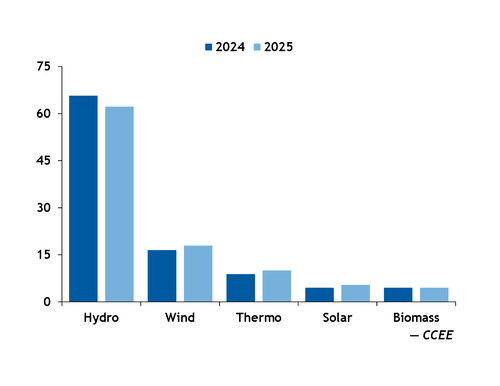
Brazil's long-delayed climate plan issued in March highlighted how extreme weather stemming from climate change could hurt its power grid and biofuels production, setting it back in achieving climate targets.
The plan is Brazil's first comprehensive roadmap for meeting its nationally determined contribution (NDC) under the Paris agreement, with a goal of reducing greenhouse gas emissions by 59-67pc by 2035, from 2005 levels.
Reaction to the plan from environmentalists was mixed. Amazon environmental research institute IPAM hailed the plan as a "reflection of Brazil commitment to mitigating climate change" and to "positioning the country as a global supplier of low-carbon products". But Brazilian climate think tank Observatorio do Clima called the plan unambitious and argued that it "caters to agribusiness". It also criticized the plan for failing to mention the phase out of fossil fuels.
The plan underscores rising risks to the power sector owing to climate change, focusing on the impact that extreme weather is already having on generation, distribution and transmission. These threats include increased frequency and duration of droughts, more extreme rainfall, catastrophic wind events and more numerous heat waves.
Drought is a top risk in the plan, owing to Brazil's continued dependence on hydroelectricity for its power supply. Even with the expansion of solar and wind generation, hydroelectricity met over 62pc of Brazil's power demand in 2025, according to the electricity sector clearinghouse CCEE.
A recent study from the mines and energy ministry demonstrated that average water levels for hydroelectric reservoirs have declined sharply in the past decade: The 10-year moving average from 2023-2012 was 68pc, while the average from 2013–2022 fell to just 41pc of maximum capacity.
The proposal seeks to expand and modernize existing hydroelectric plants to improve energy efficiency and increase installed capacity, with the goal of expanding installed capacity by 6.3GW by 2025. The plan also calls on the government to update electricity regulations to expand the use of energy storage batteries and pumped hydro plants.
Reinforcing the grid
The plan also foresees growing risks to the power transmission sector, which has suffered an increased number of outages because of extreme weather events, including flooding, high winds and fires.
Record flooding in Rio Grande do Sul state in 2024, which resulted in extended power outages for more than 1mn people, forced the government to reassess its power transmission expansion plans for the state to increase resilience of infrastructure.
The plan warned that transmission infrastructure is not designed to withstand extreme weather events and that poor engineering projects, combined with limited preventive maintenance, has increased the vulnerability of the grid.
The plan includes the addition of more than 30,000km (18,640 miles) of transmission lines by 2035 and suggested that the new infrastructure be assessed to minimize the risk of weather. The plan also calls on the government to include new technologies for grid stabilization, such as reactive power support to control voltage, secondary frequency control to balance supply and demand, and self-restoration mechanisms that help restore power quickly after power outages.
The plan also examines potential risks for the supply of biofuels, which play a central role in the decarbonization of Brazil's transport sector under the NDC. The plan calls for mandatory ethanol and biodiesel blends of 30pc and 20pc respectively in 2030, rising to 35pc and 25pc by 2035.
To guarantee adequate supply, the plan calls on the government to promote research for the biofuels sector, focusing on the development and improvement of new crop varieties and diversification of feedstocks to produce biofuels. This includes crops that can grow in different regions and that are more resilient to climate change.
It also calls on the government to promote irrigation in areas prone to drought, in an effort to limit its impact on production of sugarcane and other biofuel feedstock crops.