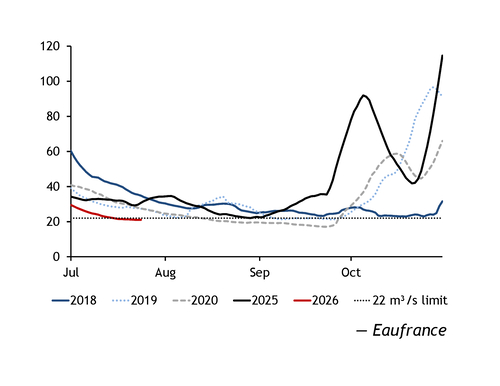
Flows on the river Meuse are at their lowest for the time of year in over 10 years, which could continue weighing on output from France's 3GW Chooz nuclear plant.
Chooz uses Meuse water for cooling, reducing the flow downstream. A 1998 treaty with Belgium obliges the plant to reduce output when flows downstream fall below 22 m³/s, and to halt completely at 20 m³/s or below.
Meuse flows at Trou du Diable upstream of the plant are at their lowest for the time of year since at least 2015 (see graph). They are much lower than in 2018-20, the only years since 2015 when there have been significant environmental curtailments at the plant after the end of August.
Restrictions were imposed at Chooz briefly during late-June's heatwave, and more consistently since 11 July. The 1.5GW unit 2 has been off line since that date, while the 1.5MW unit 1 has been subject to intermittent restrictions, mostly in the daytime. Unit 2 is scheduled to come back on 7 August, but unless rain boosts river flows, its return could end up being pushed back.
Little rain is forecast in the coming weeks. Short-term forecasts for Paris put precipitation at 20pc of the norm, while the 45-day forecast points to 50pc. There is a chance the plant might not come back until October, one market participant said.
Chooz outages often extend later into the year than those at other nuclear plants — Meuse flows tend to bottom out in August, and in some years in September-October.
The plant accounted for 70pc of the 5.8TWh of nuclear output lost in France in September-November of 2015-25 because of environmental curtailments. The 2.6GW Saint Alban made up 21pc, while four other plants — Blayais, Bugey, Cattenom and Tricastin — accounted for 9pc between them.
The potential for a Chooz outage could justify some of the strength in French September and October power contracts in recent weeks. While there have been outages in 2025-26, before this there were none since 2020. But the 2018-20 outages each took at least 1TWh off line in September-October. In 2018, over 600GWh was lost in each of these months, while 2020 outages were concentrated in September, reducing output by 2.2TWh.
French monthly contracts have risen sharply in recent weeks on record-breaking heat, nuclear curtailments and a worsening drought.
But market participants have questioned whether this is fully justified for September and October, or whether it projects beyond the horizon justified by fundamentals. Heat-based restrictions at nuclear plants are typically heaviest in July-August, falling off rapidly from September. And September forecasts point less to above-average temperatures than those for August.