Governments' efforts to fight fuel poverty and ensure supply security will see regional imports rise, writes Efcharis Sgourou
South America's largest LPG importers — Brazil, Chile and Colombia — are expected to ramp up their intake in the coming years as their domestic markets expand significantly, delegates heard at the Liquid Gas Week conference held in Istanbul, Turkey, over 12-16 October.
The US is likely to be their major supplier, but will be increasingly supported by Argentina as it expands its export capacity in the coming years and benefits from trade routes free from bottlenecks and geopolitical disputes, the audience heard.
Brazil is already tackling fuel poverty by providing around 15.5mn more low-income households with LPG for cooking through its Gas do Povo scheme, which it successfully rolled out by July — although demand has yet to significantly rise. "Two million low-income households still cook mainly using firewood, mostly in rural areas [that are easy to reach], so this is a problem we should address," the Brazilian energy ministry's national secretary for oil, gas and biofuels, Renato Dutra, said.
The government launched Gas do Povo, or People's Gas, in November 2025 as a replacement to the Auxilio Gas scheme, which targeted around 5.5mn homes but struggled with subsidy leakage. "We plan to target 17mn families, around 60mn people, or 30pc of the Brazilian population. [Gas do Povo] has a budget of $1bn/yr, so we have tripled the target without increasing the budget a lot," Dutra said.
The scheme has so far reached around 14.7mn families. Many of the remaining household beneficiaries are located in remote regions with limited access to conventional distribution infrastructure. LPG cylinders must be transported by river to communities in parts of the Amazon that cannot be reached by road.
Reaching the remaining households is likely to prove the most difficult stage of the rollout, according to Dutra. "We need to do more — we have to close the last-mile gap."
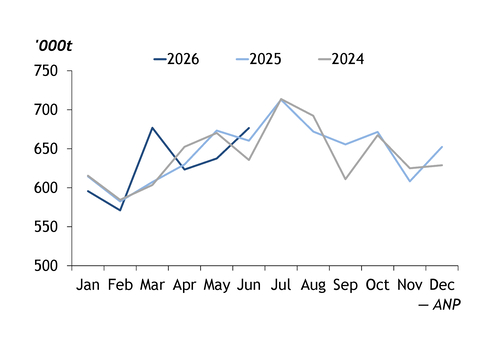
As well as being expected to import more LPG, Brazil is increasingly diversifying its supply sources. The country imported 1.6mn t of LPG in 2025, down from 1.8mn t in 2024, according to Kpler data, which was largely owing to higher domestic output from gas processing and refineries. But it also increasingly brought in supply from Argentina, taking a record high 720,000t, or 45pc of the total, up from less than 600,000t, or 33pc, a year earlier. Imports from the US stood at 800,000t, retaining the majority share but dropping by 30pc. This trend has continued this year. Brazil has imported just under 1mn t of LPG as of mid-October, with Argentina supplying 422,000t of this, equivalent to 42pc of total inflows.
Milking the cow
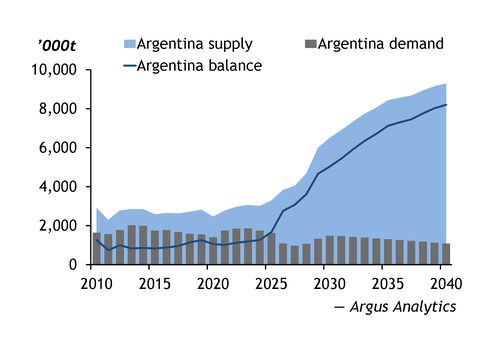
This diversification is backed by Argentina's emergence as a major LPG exporter as it develops its Vaca Muerta shale basin. State-owned YPF expects LPG production in the country to rise to 7mn-9mn t/yr by or after 2031, up from just under 3mn t/yr currently, creating additional export opportunities, the company's general manager Juan Gimenez said.
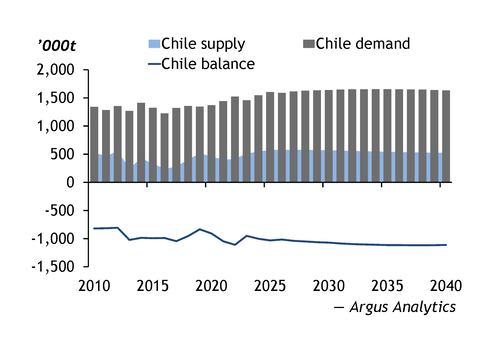
Chile is another importer that could benefit from more Argentinian supply. The country imported more than 1mn t of LPG in 2025, with almost all its cargoes from the US Gulf coast. But declining domestic production and growing concerns around supply security are prompting buyers to explore alternative sources.
"Today we import most [LPG] from the US, from Houston, [so] of course Argentina could be an important supplier not just for Chile but for South America," Chile-based LPG distributor Abastible's chief executive Joaquin Cruz said. Chile is likely to become increasingly reliant on imports as domestic production declines. Supply security has also become a higher priority following disruptions to global trade routes and restrictions at the Panama Canal. "The next 3-4 years, we could change where we are supplying [from]," Cruz said.
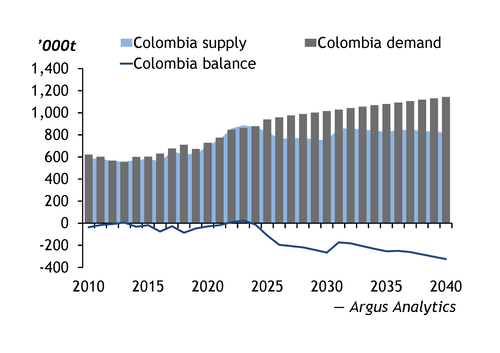
In Colombia, rising LPG demand is being driven primarily by declining domestic natural gas availability and higher gas prices, which have encouraged consumers and industries to switch to LPG. The country's imports are expected to increase to meet this additional demand, but unlike Brazil and potentially Chile, the economics for receiving more from Argentina are slightly less compelling.
Colombia relies on its seaborne imports from the far nearer US Gulf coast and the Dominican Republic. Arrivals so far this year stand at around 500,000t, the largest on record and putting them on course to nearly triple from 2025, Kpler data show. Around 60pc of Colombia's LPG imports this year originated from the US and most of the balance the Dominican Republic, while no cargoes have been imported from Argentina since records began.
The domestic industry is "prepared" and investing in import facilities and distribution infrastructure as demand grows, backed by lower natural gas availability and higher gas prices, Colombian LPG association Gasnova president Alejandro Martinez told the event. "We are growing [and] we are prepared," Martinez said. "We are satisfying the need of the people, and we are providing the country security supply through diversification of energy sources."
And as trade and geopolitical disruptions continue to play out, South Americans are becoming increasingly aware of the importance of resilience and diversification.