
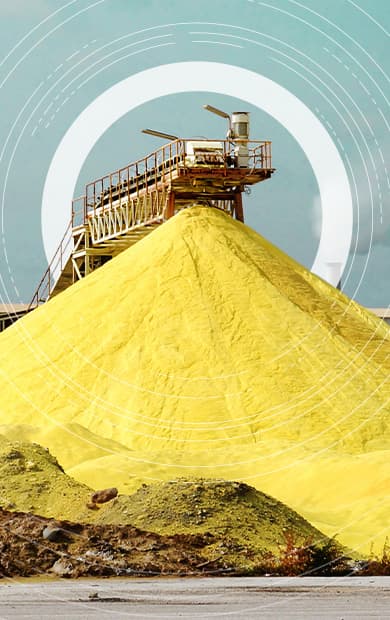
Sulphur and Sulphuric acid
Overview
The global sulphur market has gone through fundamental changes in buying patterns, trade routes and pricing over the past few years. Fixed price contracts and formula-based indexation have become the dominant ways in which supplies are bought and sold around the world, which makes accurate price assessments and detailed analysis key to any sulphur market participants.
The global sulphuric acid industry has seen structural change in recent years and new capacities will continue to challenge the balance in the years to come. While demand will be driven by fertilizers — predominantly the increased production of phosphate and ammonium sulphates — the market will continue to be exposed to short-term supply shocks, especially from the metals sector.
Rising demand for battery materials such as nickel and cobalt (due to growing electric vehicle production) will in turn bolster demand for sulphur and sulphuric acid, increase competition for supply and impact pricing.
Our extensive market coverage includes formed sulphur (both granular and prilled), crushed lump sulphur, molten/liquid sulphur and sulphuric acid. Argus has decades of experience covering these markets, and incorporate our multi-commodity market expertise in key areas including phosphates and metals to provide the full market narrative.
Argus support market participants with:
- Price assessments (daily and weekly for sulphur, weekly for sulphuric acid), proprietary data and market commentary assessments
- Short and medium to long-term forecasting, modelling and analysis of sulphur and sulphuric acid prices, supply, demand, trade and projects
- Bespoke consulting project support
Latest sulphur and sulphuric acid news
Browse the latest market moving news on the global sulphur and sulphuric acid industry.
Abu Dhabi's Adnoc cuts Oct sulphur price by $70/t
Abu Dhabi's Adnoc cuts Oct sulphur price by $70/t
London, 2 October (Argus) — Abu Dhabi's state-owned Adnoc has lowered its October sulphur official selling price (OSP) for the Indian subcontinent to $890/t fob Ruwais, down from its $960/t fob September OSP. Adnoc's October OSP implies a delivered price of $1,035-1,040/t cfr India, with the freight cost for a 40,000-45,000t shipment to the east coast of India last assessed at $145-150/t on 1 October. By Maria Mosquera Send comments and request more information at feedback@argusmedia.com Copyright © 2026. Argus Media group . All rights reserved.
Turkish Tupras awards October domestic sulphur tender
Turkish Tupras awards October domestic sulphur tender
London, 1 October (Argus) — Prices in Turkish refiner Tupras' October domestic sulphur tender were stable overall, with the midpoint down by just $1/t month on month. Sharply higher Izmit awards offset weaker Kirikkale prices, and all awards cleared well above floor levels, indicating robust demand. Tupras awarded its October e-tender in full across 29-30 September at $818-918/t fca for various lot sizes. Its previous tender, awarded on 28 August, was at $856-882/t fca. October awards were as follows: From Izmit — 100-2,250/t lots at $912-918/t fca, against September prices of $856-867/t fca. A floor price of $675/t fca was set for Izmit lots. From Izmir — 100-750t lots at $863-872/t fca, against September prices of $866-875/t fca. A floor price of $710/t fca was set for Izmir lots. From Kirikkale — 100-800t lots at $818-836/t fca, against September prices of $872-884/t fca. A floor price of $710/t fca was set for Kirikkale lots. By Fenella Rhodes Send comments and request more information at feedback@argusmedia.com Copyright © 2026. Argus Media group . All rights reserved.
Sulphur firm Solvadis acquires French Citis Group
Sulphur firm Solvadis acquires French Citis Group
London, 30 September (Argus) — Sojitz Solvadis has acquired 100pc of French sulphur distributor Citis Group — including Citis SAS and Citis Forming SAS — from PFL Resources, the firm announced today. The acquisition adds Citis' liquid sulphur distribution, storage and sulphur pastille production assets in France — including facilities at Le Havre, Marseille and Dunkirk — to Solvadis' existing European sulphur and sulphuric acid business. The deal creates further presence for the firm in the French sulphur market and will increase its sulphur storage and solid sulphur-forming capacity in western Europe. Founded in 1952, Citis distributes liquid sulphur in France and selected European and northwest African markets, while Citis Forming has operated a sulphur-forming plant in Dunkirk since 1985. By Fenella Rhodes Send comments and request more information at feedback@argusmedia.com Copyright © 2026. Argus Media group . All rights reserved.
QatarEnergy drops October sulphur price by $45/t
QatarEnergy drops October sulphur price by $45/t
London, 30 September (Argus) — State-owned QatarEnergy Marketing has dropped its October Qatar Sulphur Price (QSP) to $835/t fob Ras Laffan/Mesaieed, down from $880/t fob in September. Freight rates were last assessed at $150-160/t for a 30,000-35,000t shipment to Chinese ports on 24 September. This implies a delivered cost of $985-995/t cfr, with additional insurance premiums raising prices further on a delivered basis. Vessel traffic through the strait of Hormuz remains constrained, with recent missile and drone attacks on tankers and bulk vessels keeping costs high due to elevated risk. The flow of sulphur shipments through the strait has settled at around 1-3 vessels crossing per week. By Maria Mosquera Send comments and request more information at feedback@argusmedia.com Copyright © 2026. Argus Media group . All rights reserved.

Argus Fertilizer Market Highlights
The complimentary Argus Fertilizer Market Highlights package includes:
• Bi-weekly Fertilizer Newsletter
• Monthly Market Update Video
• Bi-monthly Fertilizer Focus Magazine
Spotlight content
Browse the latest thought leadership produced by our global team of experts.

Global Ammonia Market Dynamics & Impact of US‑Iran Conflict, CBAM
Global Ammonia Market Dynamics & Impact of US‑Iran Conflict, CBAM
Global Sulphur & Sulphuric Acid Market Dynamics & Impact of US-Iran Conflict
Global Sulphur & Sulphuric Acid Market Dynamics & Impact of US-Iran Conflict
Global DAP Market Dynamics & Outlook: Opportunities for Pakistan?
Global DAP Market Dynamics & Outlook: Opportunities for Pakistan?


Explore our sulphur and sulphuric acid products
Region and country focused market intelligence
Related events
No Results Found