

Alternative marine fuels
Overview
The marine fuel sector is decarbonising. International Maritime Organization (IMO) requirements and EU legislation is driving this change alongside consumer demand for low carbon solutions.
These drivers have prompted shipowners to invest in alternative marine fuels including; marine biodiesel, bio-methanol, grey methanol, LNG, ammonia and hydrogen.
Argus provides pricing, insights, and intelligence for the fast-growing alternative marine fuels market with independent news, analysis, and market commentary on emerging changes and trends so you can stay ahead.

Argus Market Highlights: Marine Fuels
Get the latest industry news, insight and analysis sent directly to your inbox.
Sign upSpotlight content
Browse the latest thought leadership produced by our global team of experts.
Dutch marine ticket prices surge on shortfall concerns
Dutch marine ticket prices surge on shortfall concerns
London, 31 July (Argus) — Dutch marine ticket prices reached a four-month high this week, as buyers rushed to secure the tradeable compliance credits after port sales data highlighted a potential shortfall in biofuel supply needed for the Netherlands' shipping renewable energy mandate. Dutch regulations state marine fuel suppliers must cut greenhouse gas (GHG) emissions by 2.9pc in 2026, rising to 8.2pc by 2030, against a baseline of 94g CO2e/MJ. Compliance is demonstrated through surrender of renewable fuel tickets, called ZREs, which are generated when renewable fuels are supplied. These can be traded. Fuel suppliers can either blend renewable fuels or purchase ZREs from over-compliant peers. But Port of Rotterdam data show marine biodiesel sales, although sharply up on the year, appear to remain below what is needed to generate enough ZREs for all Dutch bunker fuel suppliers to meet their 2026 obligations. A shortfall could call into question a strategy pursued by several conventional fuel suppliers, who intended to meet part — or all — of their obligations through ticket purchases rather than physical biofuel blending. ZRE-Gs rose to 13.40c/kgCO2e on Thursday, equivalent to $456/t of Advanced Fame blended, having been around 10.50c/kgCO2e through most of July. The full extent of any shortage is impossible to determine. The published data are limited to one port, and the consumption figures include biofuels blended with fossil fuel not just pure biofuels. The level of compliance is based on the GHG savings of the biofuel used, which varies from one batch of fuel to another. Still, Rotterdam is a key bio-bunker hub, and even conservative calculations from Argus and some obligated parties show a deficit in biofuel usage at the port. The prospect of a shortage is particularly concerning for fuel suppliers, because non-compliance can lead to an administrative fine of up to 10pc of turnover from the previous year. Participants have also questioned if any shortfall can be covered by credits from other transport sectors. While Dutch regulations allow some cross-sector flexibility, road transport LRE-G tickets have traded at around four to five times those of marine ZRE-Gs this year, limiting the likelihood of additional supply flowing into the marine market. It is also unclear if the road sector will have much surplus available, given road mandates are much higher than for maritime. The increase in ZRE prices led to a decline in B100 Advanced fatty acid methyl ester (Fame) dob Netherlands prices. They fell by $63.50/t to $1,286.50/t on 30 July, while marine gasoil (MGO) dob ARA was assessed at $1,288.50/t on the same day. This is the first time B100 Advanced Fame dob Netherlands was assessed lower than MGO since the marine biodiesel assessment began on 22 January. B100 costs on the rise Rising net B100 costs had already been supporting ZRE values before the release of the Rotterdam data, and it has been more expensive on an outright basis than conventional marine fuels throughout 2026. Although it can be at a substantial discount for shipowners, when EU ETS and FuelEU Maritime savings are taken into account, relative to fossil bunker fuels, that advantage has narrowed in recent months as FuelEU surplus values have fallen. Argus estimates FuelEU surplus prices trading in the market declined to €120/t in July from €215/t at the start of the year, reducing the potential savings for using B100 for shipowners under pooling schemes to around $430/t from around $786/t. MGO prices have risen this month, and ranged in $900-1,200/t in July. Rotterdam bunker sellers typically account for ZRE costs within outright sale prices. By comparison, outright B100 prices have ranged in $1,286.50-1,390/t, but fall to around $450-650/t after accounting for ETS and FuelEU surplus savings. The shrinking gap between B100 and conventional fuel compliance costs has added further support to ZRE demand in recent months because of the lower benefit to shipowners. By Madeleine Jenkins Send comments and request more information at feedback@argusmedia.com Copyright © 2026. Argus Media group . All rights reserved.
Regulation gap driving low German B100 prices
Regulation gap driving low German B100 prices
London, 15 June (Argus) — B100 marine biodiesel has been trading at very low prices at German ports this year, primarily — market participants said — because mismatched regulations have created an arbitrage between different regulatory regimes. B100, which is 100pc Advanced fatty acid methyl ester (Fame), has been selling at the German port of Hamburg for around €700-800/cbm in the first half of 2026, equivalent to about $914-1,044/t. This compares with the same fuel sold dob Netherlands, which averaged $1,210.10/t during 22 January-22 May. The lower price is achieved by two mechanisms, participants said. The first is a reduction in the total cost of the fuel, created by the value of German renewable fuel tickets generated via the German GHG quota system. Maritime supplies are not currently eligible for quota generation in Germany, since international shipping was excluded from the scope of the EU renewable energy directive (RED) III transposition into German law . But, separately, such fuels can nevertheless qualify for renewable ticket status if they are taxed as road transport fuels, under article §52 of Germany's energy tax law (EnergieStG). Some of the marine product sold at low prices meets EN14214 specifications, widely considered to be the "gold standard" for biodiesel products heading into road fuels. According to the German General Customs directorate, it is currently permissible for biofuels physically used in maritime transport to be counted towards the German GHG quota system, provided they meet the tax requirement. This interpretation has not been altered by the latest amendment to the quota system rules, which entered into force on 5 June. As a result, some market participants have been able to generate quotas from supplying advanced Fame into the marine sector, allowing buyers to benefit from an effective price discount reflecting the value of the quotas. The second mechanism enabling lower prices is the possibility of reclaiming the energy tax paid after the fuel has been used in international shipping. Under German tax law, energy products that have been demonstrably taxed can qualify for tax relief if they are subsequently used for exempt purposes, such as commercial maritime transport. This applies to biodiesel, meaning that buyers may initially pay the full taxed price and later apply for a refund once the fuel's maritime use is proven. This creates a structural inconsistency — taxation is required to generate renewable fuel tickets, while tax relief remains available after maritime use. The process can take many months, however, and can only be initiated after the fuel volume is completely used, which means those taking this path require credit lines and imposes some constraints on use of the loophole. Further, participants told Argus that obtaining the reduced price is only viable by bunkering B100 and other, more commonly used, blends such as B30 would not qualify. Many vessels do not burn B100 because of concerns about engine compatibility and the possible impact on warranties provided by engine manufacturers. Shipowners told Argus that often a prior approval from the engine manufacturer may be required to burn B100 while retaining warranty and insurance protection in case of any future issues. Some added that the US-Iran war has contributed to "liquidity pressures" for many companies, resulting in hesitation to take on the fuel while awaiting a tax rebate that will arrive many months after the fuel purchase. The German Federal Council (Bundesrat) has acknowledged the issue and indicated its intention to close what it describes as a loophole arising from the interaction of tax and quota rules. The concern is that fuels used in maritime transport are effectively being used to meet road transport decarbonisation targets, undermining the integrity of the system. While no concrete cases of abuse have been formally identified by customs authorities, the current framework allows for such outcomes. Some market participants have warned that any tightening of the rules could potentially be applied in a way that affects existing transactions, although there is no official confirmation of retroactive measures. Some suppliers that had previously offered discounted B100 have reportedly withdrawn such offers since March, reflecting growing regulatory uncertainty. By Hussein Al-Khalisy and Marcel Rothenstein Send comments and request more information at feedback@argusmedia.com Copyright © 2026. Argus Media group . All rights reserved.
Swiss WinGD sells first ethanol -fuelled marine engines
Swiss WinGD sells first ethanol -fuelled marine engines
Sao Paulo, 19 May (Argus) — Swiss marine engine manufacturer Winterthur Gas and Diesel (WinGD) has sold its first two ethanol-fuelled marine engines. It said last year that it would begin offering the technology . The engines will power two ore carriers to be built for China's Shandong Shipping to operate under charters for Brazilian mining group Vale. WinGD will build the engines by modifying its methanol-fuelled model, as ethanol and methanol share similar properties and combustion characteristics. "This is a clear signal that the shipboard technology and fuel infrastructure around ethanol as a marine fuel are ready, giving confidence to others considering ethanol as an option for maritime decarbonisation," said WinGD executive director of sales Volkmar Galke. Ethanol has gained traction as a marine fuel because of its potential to comply with greenhouse gas (GHG) emissions regulations. Last week, the IMO Marine Environment Protection Committee (MEPC 84) added Brazil's second-crop corn-based ethanol as a recognised fuel pathway in its life-cycle assessment (LCA) guidelines for marine fuels . Although ethanol is not a drop-in fuel, meaning vessels require retrofitting to run on it, it can absorb surplus production from countries such as Brazil. But FuelEU Maritime and the EU Renewable Energy Directive (RED III) — European regulations considered the world's most advanced for shipping — do not accept biofuels made from food crops, known as first-generation fuels, for emissions reduction because of food security risks. By Natália Coelho Send comments and request more information at feedback@argusmedia.com Copyright © 2026. Argus Media group . All rights reserved.
Rotterdam 1Q bunker sales fall sharply
Rotterdam 1Q bunker sales fall sharply
London, 16 April (Argus) — Demand for conventional marine fuels in Rotterdam fell by 28pc on the year in the first quarter of 2026, after the Netherlands implemented the EU's revised Renewable Energy Directive (RED III) at its ports. The decline also reflects disruption linked to the US-Iran war. Market participants reported a drop in Rotterdam bunker demand even before the war, as some shipowners shifted fuelling to neighbouring ports to avoid price premiums created by the Netherlands' unilateral transposition of RED III marine mandates from 1 January. Sales of very-low sulphur fuel oil (VLSFO) fell most sharply, down by 44pc from a year earlier to about 440,000t in the first quarter. High-sulphur fuel oil (HSFO) volumes dropped by 25pc to about 619,000t, while ultra-low sulphur fuel oil (ULSFO) sales fell by 13pc. Marine gasoil (MGO) and marine diesel oil (MDO) demand declined by 8pc on the year to around 361,000t. Some shipowners instead opted to bunker in neighbouring Antwerp, which forms part of the ARA hub and offers lower conventional bunker prices without requiring route changes. Others prioritised bunkering at Gothenburg in Sweden or ports in Germany, market participants said. Price differentials supported the shift. Between early February and the end of March, MGO dob Rotterdam prices averaged $12.75/t higher than the Antwerp equivalent, while VLSFO dob Rotterdam held an average premium of roughly $14.50/t over the same period. Tighter global supply has added further pressure. The effective closure of the strait of Hormuz sharply reduced bunker availability in Singapore, increasing competition for VLSFO and MGO cargoes that would otherwise be exported to the ARA hub. After the start of the US-Iran war, Rotterdam MGO prices rose by 75pc to an average of about $1,186/t in March, while VLSFO prices climbed by 57pc to an average of $710.50/t. By Gabriel Tassi Lara and Hussein Al-Khalisy Send comments and request more information at feedback@argusmedia.com Copyright © 2026. Argus Media group . All rights reserved.

US Biofuels Feedstock Markets Reignited
US Biofuels Feedstock Markets Reignited
Firming the biofuels outlook for 2026
Firming the biofuels outlook for 2026
Refining Under Strain: Supply Disruptions & Rising Oil Market Risk
Refining Under Strain: Supply Disruptions & Rising Oil Market Risk
Webinars
Biofuels Waste-Based Feedstocks Market Overview and Outlook
As of mid-2025, the waste-based feedstocks market for biofuels in Europe and Asia is experiencing a mix of stability and pressure, shaped by regional dynamics, policy shifts, and changes in global trade flows.
On demand Webinar - 12/06/25SAF Horizons - Global Market Dynamics, Policy Shifts, and Forecasts
We will hear from our freight experts as SAF policy and demand create global trading opportunities in this market.
On demand Webinar - 21/05/25Zooming into the US feedstock market and futures contracts
North America market updates, including recent regulatory changes like 45Z that are driving these markets
On demand Webinar - 06/05/25A webinar series exploring the shifting dynamics in the oil market
Explore how tariffs could influence global oil demand and reshape production dynamics.
Related documents
Alternative marine fuels key prices
Argus Marine Fuels features a comprehensive range of alternative marine fuels prices (in $/t VLSFO, $/t HSFO, and $/t MGO equivalents and $/mn Btu).
Latest events


Global alternative fuels vessel databases
Argus Marine Fuels includes access to proprietary data in three downloadable databases, providing essential insights into the changing marine fuels market:
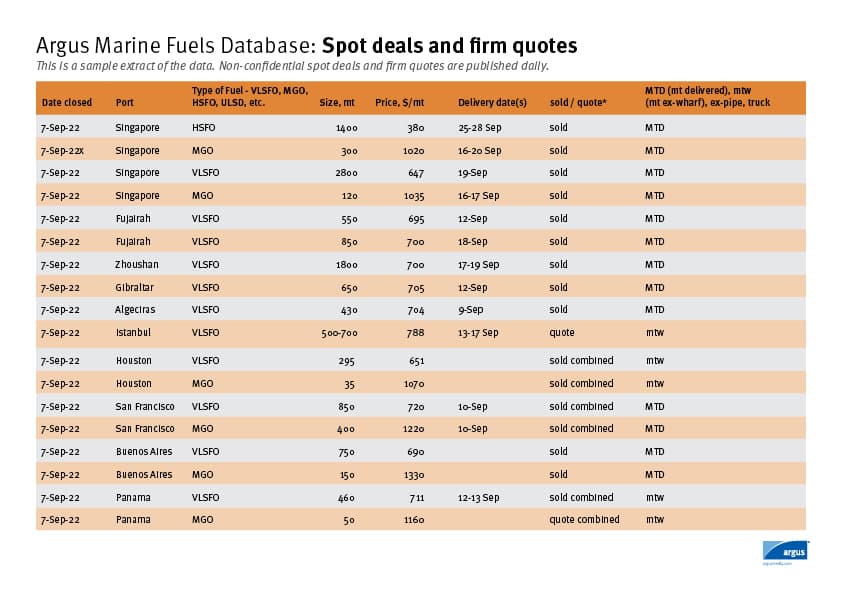
Spot deals and firm quotes
This list of spot deals gives buyers and sellers understanding where they stand price-wise compared with their competitors. Argus’ daily deals/quotes detail the port, type of fuel, size of the deal, price, delivery method and delivery dates. It does not include counterparties’ names.
View sample data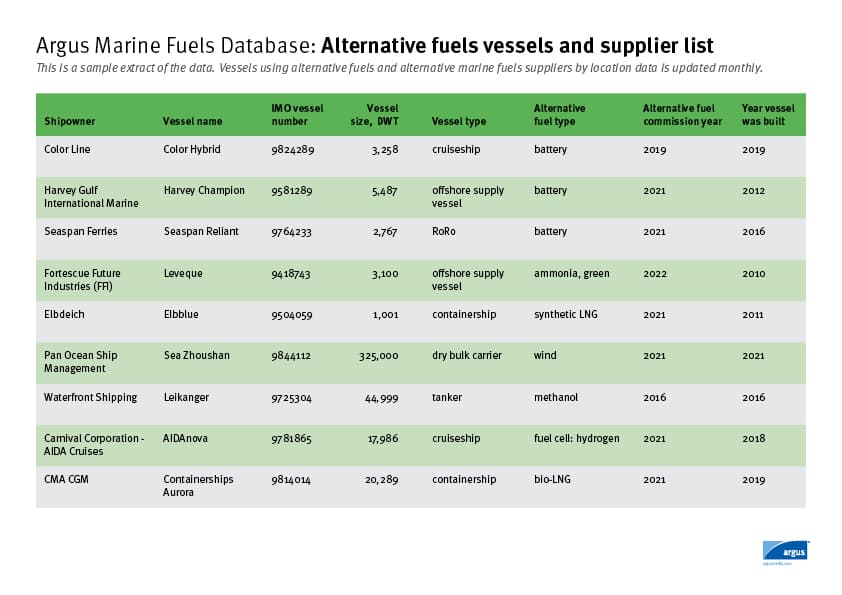
Alternative fuels vessels and supplier list
Argus lists vessels that are burning alternative marine fuels, including methanol, biofuels, ammonia, hydrogen, LNG, LPG, as well as those running on batteries. The database is updated every month.
View sample data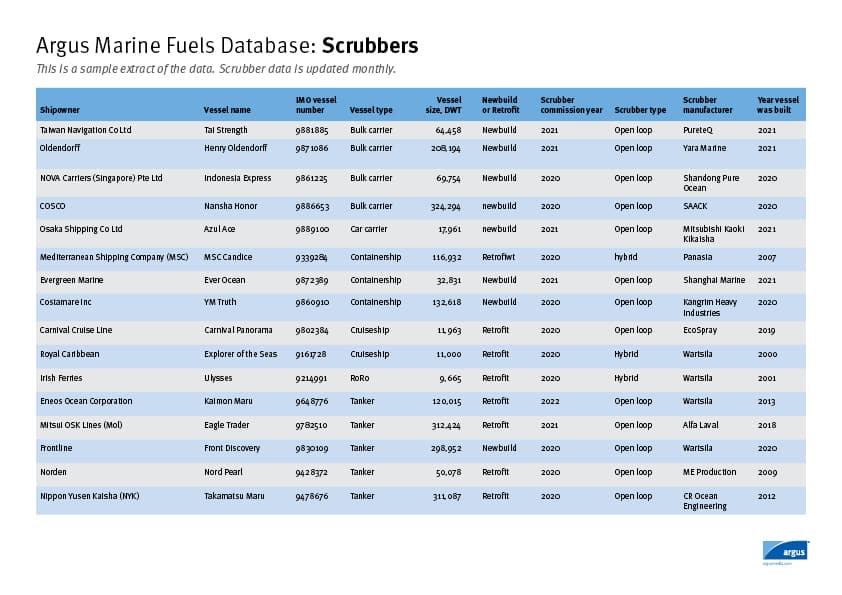
Scrubbers
The database is updated every month. It contains over 4,300 records and counting.
View sample data