
LNG
Overview
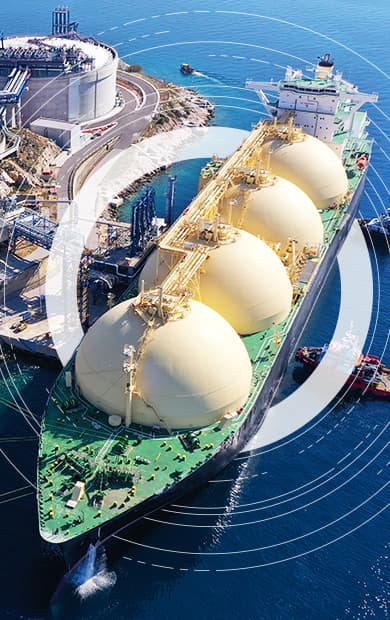
LNG's role as a key feedstock is well established as it helps manage both input costs and carbon emissions. Heavy industrial users' drive to achieve net zero targets has added a new dimension to how and where it is being deployed. Overall, its use is expected to increase and is tipped to become the strongest-growing fossil fuel.
At Argus, we expertly provide in-depth and reliable perspectives on the international LNG market. Our clients receive live access to critical data sets and analytics, comprehensive analysis and market-moving industry news. Our LNG service is the product of our market experts, who are based in all of the principal LNG trading hubs around the world.
Companies, trading firms and governments in 160 countries trust our data to support making more intelligent decisions, analysing situations, managing risk, facilitating trading and long-term planning.
Latest LNG news
Browse the latest market moving news on the global LNG industry.
Ships abort Hormuz transit attempts
Ships abort Hormuz transit attempts
Singapore, 18 April (Argus) — At least 21 vessels that attempted to leave the Mideast Gulf following a brief reopening of the strait of Hormuz were forced to turn back, vessel tracking data show, after Tehran reimposed transit restrictions in response to the continued US naval blockade of Iranian ports. Tracking data indicate that at least 15 of the vessels were tankers across all size classes. Most of the ships had been trapped in the region since the US-Iran war began on 28 February. They appear to have moved after a short-lived opening was signalled on Friday, when Iranian foreign minister Seyed Araghchi announced that the strait would be open. US president Donald Trump said shortly afterwards that the waterway was completely open. But Iran has since reversed course , saying Hormuz would not remain open while the US naval blockade of Iranian ports remains in place and that transit had returned to strict military control. The rapid change in the status of Hormuz transits has raised questions about US president Donald Trump's comment on Friday that Washington was "very close" to a full deal with Tehran. By Sea Lui Send comments and request more information at feedback@argusmedia.com Copyright © 2026. Argus Media group . All rights reserved.
Hormuz will not remain open under US blockade: Ghalibaf
Hormuz will not remain open under US blockade: Ghalibaf
New York, 17 April (Argus) — Iranian parliamentary speaker Mohammad Bhager Ghalibaf on Friday said the strait of Hormuz will not remain open while the US continues to blockade Iranian ports, seemingly contradicting a statement made by the country's foreign minister earlier in the day. "Passage through the strait of Hormuz will be conducted based on the designated route with Iranian authorization," Ghalibaf, posted on X at 6:14pm ET Friday (22:14 GMT). "Whether the strait is open or closed and the regulations governing it will be determined by the field, not by social media." Ghalibaf led the Iranian delegation during the negotiations with the US in Islamabad, Pakistan, last weekend. Iranian foreign minister Seyed Araghchi had said earlier on Friday the strait would be open to commercial vessels for the duration of the US-Iran ceasefire, after Israel and Lebanon agreed to their own ceasefire. US president Donald Trump moments later said the strait was "COMPLETELY OPEN" and ready for passage. But Trump said the naval blockade the US military began enforcing against vessels entering or leaving Iranian ports on 13 April would remain in full effect until "OUR TRANSACTION WITH IRAN IS 100% COMPLETE". Marine Traffic Vessel tracking data in the region showed a large number of vessels setting sail to exit the strait of Hormuz following the news that it was open for commercial transit. Vessels attempting to exit the strait indicated affiliations with France, India, Turkey and China in the destination fields of their automatic identification systems. Many of the vessels that were attempting to depart have either made U-turns or have stopped, vessel tracking data show. The claims that the strait of Hormuz was open for commercial traffic were met with skepticism by the shipping community and observers. "The announcement from 17 April at around 1400 GMT by US president Donald Trump that the strait of Hormuz is fully open is inaccurate," shipping association BIMCO's chief security officer Jakob Larsen said. "Iran is still in control of how ships navigate" the strait of Hormuz, Noam Raydan, a senior research fellow at the Washington Institute for Near East Policy, posted on X on Friday. "There's a new navigation order in Hormuz. Iran should be expected to continue maintaining influence over the maritime domain." By Charlotte Bawol Send comments and request more information at feedback@argusmedia.com Copyright © 2026. Argus Media group . All rights reserved.
Shipowners wary after Hormuz reopening pledge: Update
Shipowners wary after Hormuz reopening pledge: Update
Adds Bimco comment in final paragraph London, 17 April (Argus) — Iran's announcement that the strait of Hormuz is open to commercial vessels is unlikely to trigger an immediate pickup in tanker traffic through the waterway, as shipowners remain wary of security risks and the terms of passage remain unclear, market sources told Argus . Iran said on Friday that the strait would be open for commercial shipping for the duration of the US-Iran ceasefire, following a halt to fighting in Lebanon. But the limited timeframe and lack of detail are likely to deter shipowners from resuming transits straightaway, participants said. Owners would probably still have to "co-ordinate with Iran and adhere to their rules, unless of course the conditions are specified and more clarity appears, in which case more ships would consider the transit", one market participant said. Questions also remain around routing and tolls. Iran said passage would be permitted on the "co-ordinated route as already announced", which is likely to refer to the channel between the islands of Qeshm and Larak. This could imply that Iran will continue charging transit tolls. Transits through the strait have continued despite the US naval blockade on ships entering or leaving Iranian ports, which President Donald Trump has said will remain in place until peace talks with Iran are concluded. But the blockade is focused on the mouth of the Gulf of Oman rather than the strait itself, raising concerns that vessels exiting the waterway could still be intercepted further downstream, participants said. At least 10 vessels crossed the strait of Hormuz with their AIS transponders active in the past 24 hours, most of them westbound into the Mideast Gulf. Of those crossings, three were eastbound. These included the Shalamar , a Pakistani-flagged Aframax tanker that loaded at Das Island on 12 April and is heading to Karachi, according to Kpler data. The announcement about reopening the strait may be aimed primarily at allowing vessels already in the Gulf to exit, easing vessel availability constraints, rather than encouraging ships to enter for new business, according to one market participant. The International Maritime Organisation (IMO) is assessing Iran's announcement for compliance with freedom of navigation and use of the IMO-recognised traffic separation scheme. Shipping association Bimco, meanwhile, said the announcement does little to change the risk outlook for vessels. Trump's claim that the strait is "fully open" is inaccurate, as the status of mine threats within the traffic separation scheme remains unclear, Jakob Larsen, Bimco's chief safety and security officer, said. The scheme has not been declared safe for transit, and shipping companies should "consider avoiding the area", he added. By Rhys van Dinther Send comments and request more information at feedback@argusmedia.com Copyright © 2026. Argus Media group . All rights reserved.
Tanker owners wary after Hormuz reopening pledge
Tanker owners wary after Hormuz reopening pledge
London, 17 April (Argus) — Iran's announcement that the strait of Hormuz is open to commercial vessels is unlikely to trigger an immediate pickup in tanker traffic through the waterway, as shipowners remain wary of security risks and the terms of passage remain unclear, market sources told Argus . Iran said on Friday that the strait would be open for commercial shipping for the duration of the US-Iran ceasefire, following a halt to fighting in Lebanon. But the limited timeframe and lack of detail are likely to deter shipowners from resuming transits straightaway, participants said. Owners would probably still have to "co-ordinate with Iran and adhere to their rules, unless of course the conditions are specified and more clarity appears, in which case more ships would consider the transit", one market participant said. Questions also remain around routing and tolls. Iran said passage would be permitted on the "co-ordinated route as already announced", which is likely to refer to the channel between the islands of Qeshm and Larak. This could imply that Iran will continue charging transit tolls. Transits through the strait have continued despite the US naval blockade on ships entering or leaving Iranian ports, which President Donald Trump has said will remain in place until peace talks with Iran are concluded. But the blockade is focused on the mouth of the Gulf of Oman rather than the strait itself, raising concerns that vessels exiting the waterway could still be intercepted further downstream, participants said. At least 10 vessels crossed the strait of Hormuz with their AIS transponders active in the past 24 hours, most of them westbound into the Mideast Gulf. Of those crossings, three were eastbound. These included the Shalamar , a Pakistani-flagged Aframax tanker that loaded at Das Island on 12 April and is heading to Karachi, according to Kpler data. The announcement about reopening the strait may be aimed primarily at allowing vessels already in the Gulf to exit, easing vessel availability constraints, rather than encouraging ships to enter for new business, according to one market participant. The International Maritime Organisation (IMO) is assessing Iran's announcement for compliance with freedom of navigation and use of the IMO-recognised traffic separation scheme. The review adds to uncertainty for shipowners, who may be reluctant to use a route that has not been formally endorsed. By Rhys van Dinther Send comments and request more information at feedback@argusmedia.com Copyright © 2026. Argus Media group . All rights reserved.
Spotlight content
Browse the latest thought leadership produced by our global team of experts.


Explore our LNG products
Real time access to our independent and trusted benchmarks, critical market data and analytics, in-depth analysis, and the latest market news. Argus LNG is relied upon by energy companies, governments, banks, regulators, exchanges and many other organizations as source of reliable and unique insights into the global markets.
Key price assessments
Argus prices are recognised by the market as trusted and reliable indicators of the real market value. Explore some of our most widely used and relevant price assessments.